


Voice AI for Ecommerce and Retail: 4 Real Cases on Calls
A retailer cut wait times to 33 seconds. A gear brand cut returns 20% with phone AI. Four published retail cases on calls, returns and customer support.
John Park, Founder, Nebula AI12 min read
- Can voice AI for ecommerce cut returns and wait times?
- What a virtual assistant did for a recreational vehicle retailer
- How an auto-parts retailer's voice assistant cut handling time 10%
- How phone AI cut returns 20% for a photography gear brand
- What a voice assistant reportedly did for a beauty retailer's website
- What the four retail cases prove about calls, returns and waits
- What to copy first
- If you want to build this
The short version: Voice AI for ecommerce earns its keep on the cost side. A photography gear brand reports a 20% drop in returns after AI took its tech-support calls, and an auto-parts retailer cut handling time per call by 10% by having a voice assistant collect details before an agent picked up.
Some returns are really support calls nobody answered. A customer who cannot get a product to work does not file a ticket. They box it up and send it back.
That is the quiet cost of a weak phone line in retail. The sale was fine, the product was fine, and the person on the other end could not get an answer in the five minutes they were willing to spend. The return gets booked as a returns problem, and the real problem sat in the support queue.
Four published examples follow, from vendors' own case studies. The companies are anonymized and the sources stay named, so every number can be checked: a recreational vehicle retailer, a German auto-parts retailer, a photography gear brand, and a beauty retailer. One of the four rests on unverified figures, and it is labeled that way. A wider set across industries sits in a roundup of real voice and answering outcomes.
Can voice AI for ecommerce cut returns and wait times?
Yes, in the cases that report it. A photography gear brand reports 20% fewer returns after AI took its tech-support calls, and an auto-parts retailer cut handling time per call by 10%. Both numbers are vendor-reported. In each case the assistant took a known, repeatable job and handed the rest to a person.
Notice what is missing from that answer: nobody claims the assistant sells. The reliable wins in these cases come from the cost side, fewer returns, shorter calls, and shorter waits.
The other thing worth knowing is that retail support is not one problem. A parts retailer needs vehicle data before an agent can help. A gear brand needs someone to walk a customer through setup. A retailer with three kinds of customers needs coverage after hours. These cases are three different jobs.
What a virtual assistant did for a recreational vehicle retailer
Situation
A recreational vehicle retailer that serves three kinds of customers: shoppers, buyers of financial services such as insurance, and dealerships. After the pandemic, a surge of customers exposed gaps in how its contact center was staffed and managed. It had no 24/7 coverage, so a question asked after hours went unanswered, got pushed to the next day, or was dropped. The sales team had no view of how many leads piled up overnight.
Pulling an agent from one business unit to another takes training the company did not have time for before its seasonal surge. A person who knows retail cannot instantly field a dealership question.
What changed
The retailer deployed a virtual assistant across its web properties, built on an enterprise AI assistant platform and tied into its chat platform. It started with 75 to 100 intents, the kinds of questions customers ask, and the team adjusted them wherever customers hit roadblocks. Later versions let a caller on the phone switch to SMS, and added outbound SMS campaigns. The assistant connects to the retailer's customer data systems and hands off to a live agent warmly when a conversation gets complicated. It also captures leads after hours, which the team could not see before.
This is an AI virtual assistant working across web chat, phone, and SMS, with live agents behind it.
Results
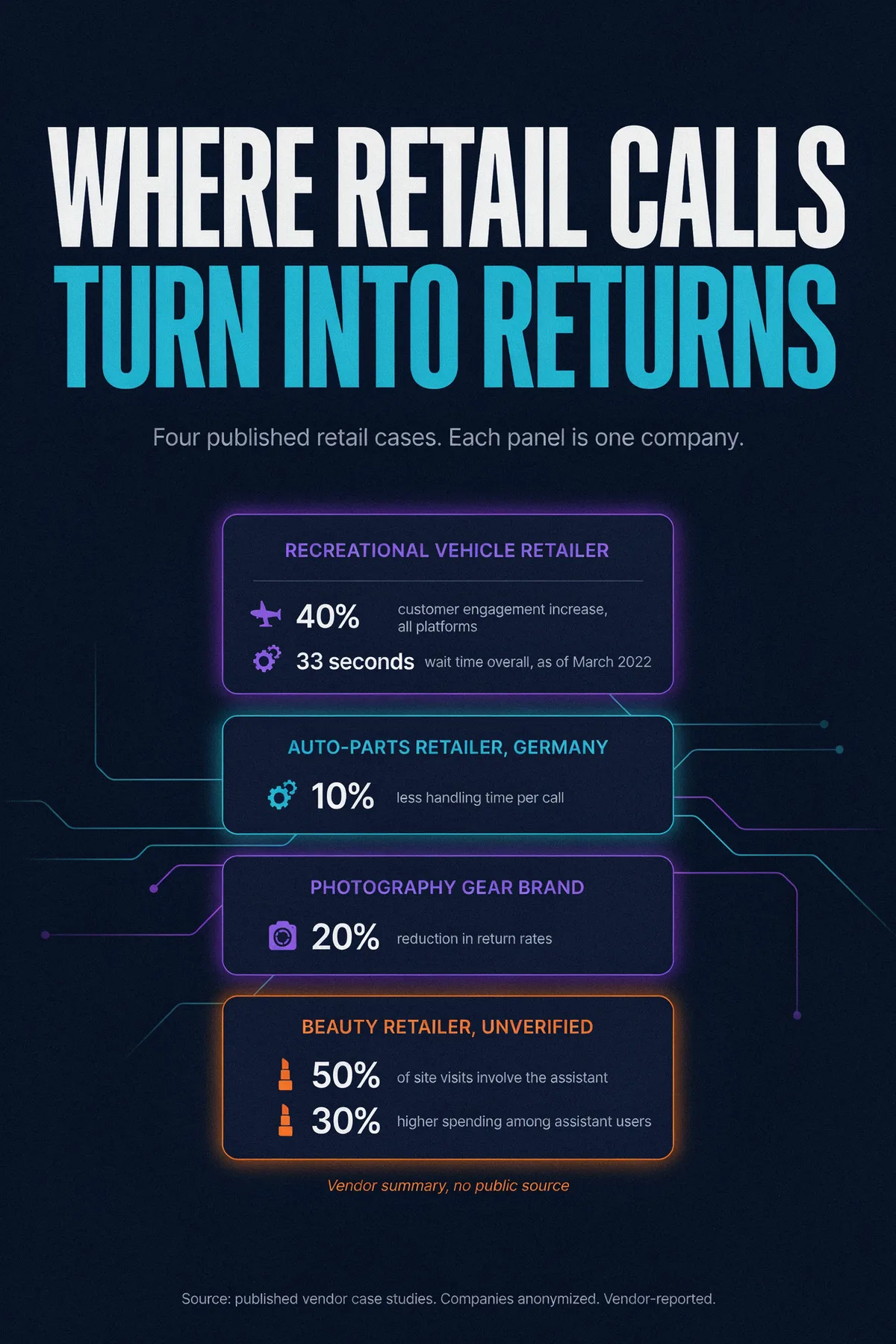
As of March 2022, customer engagement was up 40% across all platforms. Agent efficiency was up 33%, and wait times had come down to 33 seconds overall.
| What the published account reports | Detail |
|---|---|
| Customer engagement, all platforms | Up 40% |
| Agent efficiency | Up 33% |
| Wait times | 33 seconds overall |
| As of | March 2022 |
| Starting scope | 75 to 100 intents, 30+ FAQs |
Read the wait figure carefully. The source says wait times came down to 33 seconds. It does not say they fell by 33 seconds. The 40% is engagement, which the page does not define, and the whole set is more than four years old. It still shows a company with no after-hours coverage finding out how many leads it had been losing.
How an auto-parts retailer's voice assistant cut handling time 10%
Situation
A German online auto-parts retailer that ships up to 16,000 parcels a day and employs more than 300 people. Phone calls are a big channel, about 600 a day by one company statement, and many of them dragged. Callers often did not have the data an agent needed, such as the chassis number, so the agent waited on the line while the customer went to look it up. That waiting time helped nobody.
What changed
The retailer put a voice assistant it calls its "gatekeeper" in front of the service line. The assistant answers, collects the information in natural speech, and connects the caller to the right service employee. The agent sees what the caller said at the start of the call. Now the software waits patiently for the information and the person does not.
This is AI voice intake. A human agent still resolves the call.
Results
The assistant understands over 86% of requests immediately. Average handling time per call is down 10%, and 90% of customers accepted the voice assistant.
| What the published account reports | Detail |
|---|---|
| Understanding and assignment rate | Over 86% |
| Average handling time per call | Down 10% |
| Customer acceptance | 90% |
| Scale | Up to 16,000 parcels a day, 300+ employees |
| Phone volume (company statement) | About 600 calls a day |
The 90% is acceptance, which means customers did not reject the assistant. It is not a satisfaction score. And the 86% describes how many requests the assistant understood, not how many it resolved, because the agent resolves them. Ten percent is not dramatic. It is the honest size of a win where the software handles intake and a person handles the problem.
How phone AI cut returns 20% for a photography gear brand
Situation
A photography and creator-gear brand with a strong online and retail presence. It had a high return rate because of unresolved technical issues. Customers often chose to return a product rather than ask for help, which meant lost sales, and its support team was stretched thin answering the same setup questions again and again.
What changed
The brand deployed an AI phone support agent for technical support. It troubleshoots common issues, walks customers through simple fixes, and escalates to a person when it needs to. It plugs into the brand's support platform and is available around the clock, which matters for a customer stuck on a setup problem at night.
This is an AI voice agent on a support line, aimed at one specific job.
Results
The brand reports a 20% reduction in return rates. It reports 85% customer satisfaction with issue resolution and 90%+ satisfaction for overall service interactions.
| What the published account reports | Detail |
|---|---|
| Reduction in product return rates | 20% |
| Satisfaction with issue resolution | 85% |
| Overall service satisfaction | 90%+ |
| Channel | AI phone support, tech support |
| Availability | Around the clock |
The page gives no baseline return rate, no timeframe, and no count of customers, so the 20% is a percentage of an unknown starting point. It also describes the 85% two ways, as satisfaction with resolution and as an issue resolution rate. Even so, this is the cleanest example in the post of AI paying off outside the call center, in the returns line of a P&L.
What a voice assistant reportedly did for a beauty retailer's website
Situation
A global beauty retailer with a large online catalog. Shoppers face a big range of products and a lot of generic recommendations, and little real-time guidance on what suits them.
What changed
According to the vendor summary, the retailer put a voice AI assistant on its website to give personalized skincare advice in a natural conversation, mimicking an in-store consultation.
No public page from the retailer or the vendor backs this one up. It comes from a vendor case-study document circulated without a source, so treat every figure here as unverified. The layer is a voice assistant on a website, not a phone line.
Results
The document reports that 50% of site visits involve the assistant, that 30% more is spent among assistant users, and that 75% of users were satisfied with its recommendations.
| What the unverified summary reports | Detail |
|---|---|
| Site visits that involve the assistant | 50% |
| Spending among assistant users | 30% higher |
| Satisfaction with recommendations | 75% |
| Source | Vendor summary, no public page found |
The 30% compares people who used the assistant with people who did not. Shoppers who choose to use a tool tend to be the more engaged ones, so it does not show the assistant caused the extra spending. With no public source, it is a claim to check before you repeat it.
What the four retail cases prove about calls, returns and waits
Three of the four are sourced, and they point at the cost side. A gear brand cut returns 20%. A parts retailer cut handling time 10%. A vehicle retailer got wait times down to 33 seconds. The fourth case, the spending lift, is the one that sounds best and has the least behind it.
The jobs differ. One assistant solved a setup problem, one collected data before an agent, and one gave a retailer coverage after hours. Before you buy "retail voice AI," decide which of those jobs you actually have.

Photo by BaljkanN4 on Unsplash.
What to copy first
Find out which calls turn into returns. In the gear brand's case, the returns traced back to technical issues customers could not resolve. Your own returns data will show the pattern if you look for it.
Copy in this order:
- Read your last 50 returns and tag the reason. The gear brand's returns came from unresolved technical issues, and the fix was a support line, not a policy change.
- Collect before you connect. The parts retailer's assistant gathers the data first, so the agent starts the call with it on screen.
- Cover the hours you are closed. The vehicle retailer had no overnight coverage and no view of the leads that piled up.
- Plan the handoff. The vehicle retailer's assistant passes complicated conversations to a live agent. A caller should never have to repeat themselves.
- Record your baseline first. The gear brand published a 20% drop with no starting rate, which makes it hard to trust. Write yours down before you change anything.
After that, the shape of the fix is the same for ecommerce and retail: answer fast, handle the repeatable question, and give a person the details they need.
If you want to build this
The first version is a list and an owner. Write down the five questions that fill your support line, answer each one in two sentences, and put one person in charge of keeping them current. That alone shortens calls before any software.
When the call volume justifies automation, there are two layers. The first is the wiring. Make.com can pull order data or ticket details into the place your team already works, so the person who picks up has what the caller said.
The second is who answers. Voice-agent platforms like Retell AI and Vapi are where most teams start.
If you go the voice route, the voice decides whether a frustrated customer stays on the line. A November 2025 Twilio blind test found 90% of consumers could not correctly identify an AI voice from a human one, though 72% believed they could tell. Neural voices from ElevenLabs are a large part of why that gap exists. You still need your answers, a rule for when a person takes over, and a check that nothing the assistant says contradicts your return policy.
The phone-side view of this for service businesses is covered in how an AI receptionist compares to an answering service.
Not sure which calls are costing you returns? Book a free discovery call and we will map your support questions to the returns and waits they are creating, without pretending a setup line and a spending claim are the same thing.
The numbers in this article come from each provider's published case study: IBM's case study for the recreational vehicle retailer, Spitch's case study and a company press release for the auto-parts retailer, and TalkForce's case study for the photography gear brand. The beauty retailer's figures come from a vendor case-study summary with no public page found, and are unverified. These are real anonymized case studies that show what voice AI can do in practice. Some links in this post are affiliate links: if you sign up through them, we may earn a commission at no extra cost to you.
Frequently Asked Questions
Can voice AI really reduce product returns?
One photography gear brand reports a 20% reduction in return rates after an AI phone agent took its tech-support calls, because many returns were unresolved technical issues. The page gives no baseline return rate, no timeframe, and no sample size, so treat the 20% as vendor-reported and directional. The mechanism is credible: answer the setup question and the product stays.
What does a voice assistant "gatekeeper" do in customer service?
It answers the call first, collects the details an agent needs, and then connects the caller to the right person. An auto-parts retailer used one to gather vehicle data in natural speech, so the agent saw it on screen at the start of the call. The retailer reports 10% less handling time per call and a 90% customer acceptance rate.
Is the beauty retailer's 30% spending figure proof that voice AI sells?
No. It comes from a vendor case-study summary with no public page behind it, so it is unverified. Even if accurate, it says that people who used the assistant spent 30% more, which is not the same as the assistant causing them to spend more. Shoppers who choose to use a tool are usually the more engaged ones.
Do these results apply to a small online store?
The examples are large retailers and brands, so they are not proof about a ten-person shop. The pattern transfers anyway: find the one repeatable question that fills your phone line, such as setup help or order data collection, and automate that first. None of the published cases give cost figures, so price it against your own call volume.
Where do these numbers come from?
Every figure comes from a vendor's published case study, not from a Nebula AI measurement. IBM published the recreational vehicle retailer, Spitch the auto-parts retailer, and TalkForce the photography gear brand. These are real anonymized case studies that show what voice AI can do in practice. The beauty retailer's figures come from an unsourced vendor summary and are labeled as unverified.
Founder of Nebula AI. Builds AIOS for established businesses.
Get one practical AI idea for your business, once a month.
Put this to work in your business
Not sure where your phone calls are leaking?
Book a free discovery call and we will map the calls you are missing to the jobs they should have been. Half an hour, no pitch deck.
 Case Study15 min read
Voice AI for Banking: 4 Published Results on Calls
A Swiss bank cut call processing time about 20%. A US credit union reports 66% of calls automated. Four published banking cases on routine calls and waits.
 Case Study13 min read
AI Calls for Admissions and Agencies: 4 Real Results
An online school saved advisors 100,000+ minutes a month. A studio lifted leads 50% by answering every call. Four published cases on admissions and agencies.