


AI Calls for Admissions and Agencies: 4 Real Results
An online school saved advisors 100,000+ minutes a month. A studio lifted leads 50% by answering every call. Four published cases on admissions and agencies.
John Park, Founder, Nebula AI13 min read
- How do AI calls for admissions work in practice?
- What AI outbound calling did for an online vocational school
- How a Singapore university used AI calls to fill its info sessions
- What live receptionists did for a Minnesota recording studio
- How a marketing agency's clients lifted answer rates with live receptionists
- What the four cases prove about answering and filtering calls
- What to copy first
- If you want to build this
The short version: AI calls for admissions earn their keep by filtering. An online vocational school reports advisors saving 100,000+ minutes a month after AI took over the first call, and a studio lifted lead intake 50% by answering every call with live receptionists. Two cases are AI, two are people, and the labels matter.
At one online school, more than half of outbound calls were wasted before a human ever spoke.
The phone rings, it goes to voicemail, or someone picks up and hangs up, and an advisor on a salary has just spent a minute on nothing. Multiply that by a lead list and you have the real cost of enrollment calling. Agencies and studios have the opposite problem. They are busy doing the work, so the phone rings and nobody picks it up.
Four published examples follow, all from vendors' own case studies. The companies are anonymized and the sources stay named, so every number can be checked: an online vocational school, a private university in Singapore, an audio-visual production studio in Minnesota, and the clients of a digital marketing agency. Two of them used AI. Two used live people, and each panel says which. A wider set of results across industries sits in a roundup of real voice and answering outcomes.
How do AI calls for admissions work in practice?
AI calls for admissions handle the first conversation. The AI dials a new lead, confirms who they are and whether they are still interested, then passes confirmed prospects to a human advisor or sends the session link. In the published cases, that filtered out voicemail and dead air before an advisor spent a minute on it.
That is a narrower job than "AI runs enrollment," and it is the one the evidence supports. In both AI cases a person still takes the conversation that matters.
The agency and studio cases are a different layer entirely. They are about whether anyone answers an inbound call at all, and the people who answered were live receptionists.
What AI outbound calling did for an online vocational school
Situation
An online vocational school serving Hispanic students in the United States and Latin America, with programs in beauty, wellness, trades, and gastronomy. As enrollment demand grew, its contact center could not keep up. More than half of its outbound calls reached voicemail or dead air, which used up over 100,000 minutes of advisor time every month. Advisors also spent time on low-intent prospects, and scaling up meant hiring and training more of them.
Think about what that means for a team. A big chunk of every shift went to calls that went nowhere.
What changed
The school put an AI voice agent on its outbound enrollment calls. The agent verifies the student's identity, confirms interest in a program, and checks the prospect is ready to engage. It detects voicemail and dead air in real time, so those dials stop eating advisor time. A human advisor joins only once intent is confirmed. The team also refined its Spanish conversation flows along the way.
This is an AI outbound voice agent that qualifies leads and transfers confirmed ones to people.
Results
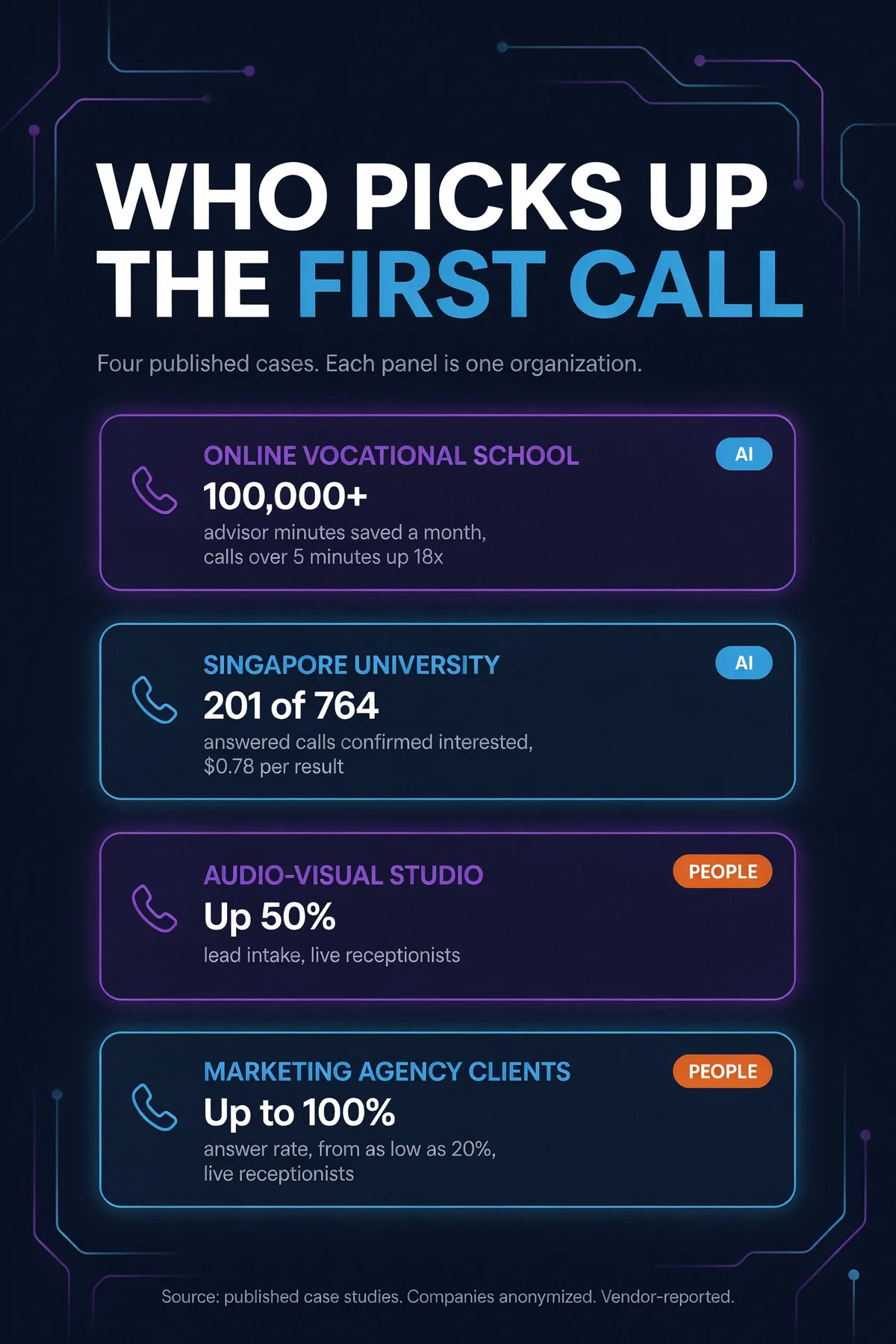
Advisors now save more than 100,000 minutes a month. Calls lasting over five minutes are up 18x, and conversion is at 100% parity with human agents.
| What the published account reports | Detail |
|---|---|
| Advisor minutes saved per month | 100,000+ |
| Calls lasting over 5 minutes | Up 18x |
| Conversion rate | Parity with human agents |
| Weekly lead volume handled | Twice that of human agents, within two weeks of launch |
| Revenue per lead | Up 6%, with conversion holding steady |
The 18x is a count of long, engaged calls, not enrollments. Parity means the AI-qualified flow converts about as well as the human one, and the 6% lift in revenue per lead is the vendor's figure with no baseline given. The number to remember is the first one. A school got more than 100,000 minutes a month back by not dialing voicemail.
How a Singapore university used AI calls to fill its info sessions
Situation
A private university in Singapore that offers a high-value executive postgraduate management program, with tuition above $20,000. Each online information session drew thousands of sign-ups, but only a fraction attended. The small admissions team could not call every registrant to find out who was still interested, and it needed more confirmed attendees to turn into applicants.
What changed
The university used an AI voice agent to call every registrant. The agent introduces itself on behalf of the admissions office, asks whether the person still wants to attend, and logs the answer. If they say yes, the system sends the session link by WhatsApp and email right away, and a reminder call goes out before the session. Everyone else is logged and left alone.
This is an AI outbound voice agent used for confirmation and reminders, not for selling.
Results
In one campaign the agent made 4,799 dials, reached 764 people, and confirmed 201 as interested, about 26% of answered calls. The cost was $0.78 per result.
| What the published account reports | Detail |
|---|---|
| Dials in one campaign | 4,799 |
| Calls answered | 764 |
| Registrants confirmed interested | 201 (about 26% of answered calls) |
| Cost per result | $0.78 |
| A second campaign | 221 confirmed at about $1.01 each |
| Follow-up | Session link by WhatsApp and email, then a reminder call |
Two limits. The cost covers telephony and platform fees, and the page defines a "result" as a confirmed-interested registrant, which is not an enrollment. The same page also headlines large percentage gains in attendance and conversion with no baseline attached, so those are left out here. The concrete numbers are the ones above.
Look at the funnel, though. Of 4,799 dials, 764 picked up. The agent did that sorting at under a dollar per confirmed person, and the admissions team started its day with a short list.
What live receptionists did for a Minnesota recording studio
Situation
A small audio-visual production studio in Saint Paul, Minnesota. The owner was working in the studio, filming, recording, and editing, and was answering only 1 of every 10 calls placed to the business. He had built a chatbot to collect information online and follow up later, but he knew some callers got no reply and never called back.
What changed
The studio signed up for a 24/7 virtual receptionist service. The people on the other end answer every call, book appointments, and schedule consultations. They give callers a first impression the owner could not give while he was working a session.
This ran on live human receptionists. It is not AI.
Results
Lead intake rose 50% since launch, and the studio has not missed an incoming call.
| What the published account reports | Detail |
|---|---|
| Calls answered before | 1 of every 10 |
| Lead intake since launch | Up 50% |
| Missed incoming calls | None reported |
| Service | 24/7 live virtual receptionists |
| Tasks handled | Booking appointments and consultations |
The 50% is a vendor-reported lift with no timeframe or lead count behind it. It is also the most useful number in the post for a small shop, because the fix was not technology. The studio went from answering 10% of calls to answering all of them. Anyone who picks up the phone beats the owner who is busy working.
How a marketing agency's clients lifted answer rates with live receptionists
Situation
A digital marketing agency with offices in New York City and London that generates leads for small and medium-sized businesses. The agency found its own work was being wasted downstream: its clients were not responding to every lead, so the revenue the campaigns created was leaking out of the clients' phones. It had watched various answering services fail its clients with inconsistent call handling and poor integrations.
What changed
The agency's founder moved his clients to a 24/7 virtual receptionist service. Live receptionists answer, qualify, and schedule new leads, and route callers to the right person or book them on a calendar. The agency also liked that the service charges per call, with spam and sales calls screened out, rather than per minute.
This also ran on live human receptionists. It is not AI.
Results
Across the clients who switched, answer rates went up to 100% from as low as 20%. Booking rates rose by an average of 10%.
| What the published account reports | Detail |
|---|---|
| Client answer rate | Up to 100% from as low as 20% |
| Booking rates | Up an average of 10% |
| Whose results | The agency's clients, not the agency's own |
| Service | 24/7 and overflow live answering |
| Integrations | CRM integration, set up in days |
The phrase "as low as 20%" describes the worst starting point among the clients, not the average. The page also does not say whether the 10% is relative or in percentage points. What it does tell you is where the leak sits. An agency can generate all the leads it likes and still lose them at the client's front desk.
What the four cases prove about answering and filtering calls
Line the four up. The two AI cases removed waste: more than 100,000 advisor minutes a month saved at one school, and 4,799 dials sorted into 201 confirmed registrants at the other. The two human cases fixed coverage: a studio went from 1 in 10 calls answered to all of them, and an agency's clients went from answer rates as low as 20% to 100%.
Those are different problems, and they are measured in different units. Minutes saved and cost per confirmed registrant belong to the AI cases. Lead intake and answer rate belong to the human ones. If a vendor puts the studio's 50% next to the school's 18x and calls it "AI results," ask which case each number came from.
None of the four won with a smarter pitch. They won by deciding who or what handles the first contact, and then measuring it.
Photo by Norman Hermle on Unsplash.
What to copy first
Count the waste before you buy anything. The online school found that more than half of its outbound calls hit voicemail or dead air. If your team dials leads, find out what your own number is.
Copy in this order:
- Count how many of your outbound calls reach a person. At the school, more than half did not, and that changed the whole plan.
- Let software do the confirmation call and keep the human for the conversation. Both AI cases kept a person on the part that matters, the advisor or the admissions team.
- Send the link while the person is on the phone. The Singapore university's agent triggered the session link by WhatsApp and email as soon as a registrant said yes, then called again with a reminder.
- Answer every inbound call, with whoever you have. The studio's 50% came from going from 1 in 10 to every call, and no software was involved.
- If you run an agency, check your clients' answer rates before you check their ad spend. The agency's clients had rates as low as 20%, which is where campaign results can leak out.
- Track cost per confirmed result. The Singapore case reported $0.78 and about $1.01 per confirmed registrant, which is a number you can compare against your own.
After that, the shape of the fix for agencies and schools is the same: reach the lead, confirm the interest, pass the confirmed one to a person, and write down what it cost.
If you want to build this
The first version is a list and a person. Take yesterday's leads, have someone call every one before lunch, and log which calls reached a human. You will learn your own contact rate before you pay for any tool.
When the lead list outgrows the manual version, there are two layers. The first is the wiring. Make.com can watch for a confirmed lead and send the session link or booking details to the right person, the same shape of follow-up the Singapore university automated.
The second is who dials. Voice-agent platforms like Retell AI and Vapi are where most teams start. That path is AI, and it is not what the studio or the agency's clients ran. They used people. Go in knowing which one you are buying.
If you go the voice route, the voice decides whether a prospect stays on the line. A November 2025 Twilio blind test found 90% of consumers could not correctly identify an AI voice from a human one, though 72% believed they could tell. Neural voices from ElevenLabs are a large part of why that gap exists. You still need a script, a rule for when a person takes over, and disclosure that fits the rules where you call.
The same response-time pattern shows up in legal, covered in voice AI for law firms.
Not sure how many of your leads are reaching a person? Book a free discovery call and we will map the calls you dial and the calls you miss to the enrollments and bookings they should have produced, without pretending an outbound AI agent and a live receptionist are the same product.
The numbers in this article come from each provider's published case study: Regal's case study for the online vocational school, Awaz.ai's case study for the private university in Singapore, and Smith.ai's case studies for the audio-visual studio and the digital marketing agency's clients. These are real anonymized case studies that show what voice AI can do in practice. Some links in this post are affiliate links: if you sign up through them, we may earn a commission at no extra cost to you.
Frequently Asked Questions
Is this AI or people making the calls?
A mix, labeled panel by panel. The online vocational school and the Singapore university used AI voice agents making outbound calls. The audio-visual studio and the marketing agency's clients used live virtual receptionists, which are people, not AI. The two AI cases and the two human cases measure different things, so do not use one set of numbers to sell the other product.
What are AI calls for admissions actually used for?
The first conversation. In both published cases the AI dials a lead, confirms identity and interest, and filters out voicemail and dead air. Then a human advisor takes confirmed prospects, or the system sends a session link and a reminder. The AI is not closing enrollments. It is deciding which leads are worth an advisor's time.
Does an AI voice agent convert as well as a human advisor?
The online vocational school reports conversion at parity with human agents, and revenue per lead up 6% with conversion rates holding steady. That is the vendor's own account, and it describes qualification calls that hand confirmed leads to people. It is not a claim that the AI closes enrollments on its own, and no independent audit backs it.
Do these results apply to a small studio or agency?
The two human cases are small businesses, and they show the plainest version of the problem: a studio answering 1 of every 10 calls, and agency clients with answer rates as low as 20%. The two AI cases are larger operations with large lead lists. A small shop can copy the answer-every-call rule first, then add automation when volume demands it.
Where do these numbers come from?
Every figure comes from a vendor's published case study, not from a Nebula AI measurement. Regal published the online vocational school, Awaz.ai the Singapore university, and Smith.ai the studio and the marketing agency's clients. These are real anonymized case studies that show what voice AI can do in practice. All results are vendor-reported, not independent audits.
Founder of Nebula AI. Builds AIOS for established businesses.
Get one practical AI idea for your business, once a month.
Put this to work in your business
Not sure where your phone calls are leaking?
Book a free discovery call and we will map the calls you are missing to the jobs they should have been. Half an hour, no pitch deck.
 Case Study15 min read
Voice AI for Banking: 4 Published Results on Calls
A Swiss bank cut call processing time about 20%. A US credit union reports 66% of calls automated. Four published banking cases on routine calls and waits.
 Case Study12 min read
AI Receptionist for Restaurants: 4 Published Results
A restaurant group booked 3,598 reservations in a year. A drive-thru chain reports 90%+ order completion. Four published cases on answering every call.