


The Law Firm That Answers First Signs the Client: 3 Cases
One firm converted 52% of the leads it reached. Another grew revenue 40% in a year. Three published legal cases on winning the client who calls first.
John Park, Founder, Nebula AI13 min read
- Do law firms really lose clients to slow response?
- What a law firm answering service did for a Clearwater injury firm
- What sales-trained calling and a virtual receptionist returned for an LA defense practice
- How a Colorado Springs defense firm automated 95% of client acquisition
- What the three legal cases prove about response time
- What to copy first
- If you want to build this
The short version: Legal is a race, and the fast firm signs the client. A Clearwater personal injury firm converted 52% of the leads its team reached, while a Los Angeles defense practice grew revenue 40% in a year. In every case, response speed is what the result traces back to.
Most firms track how many leads they generate. The difficult number to find is how long a new lead sits unanswered.
A person who has just been arrested, injured, or served papers is not shopping. They are calling down a list, often from a parking lot or a hospital bed, and the firm that reaches them first usually becomes their lawyer. When the first response slips by even an hour, a qualified lead is often gone before anyone picks up a phone.
Three published examples follow, all from Smith.ai's case studies rather than any work done here. The firms are anonymized but the source stays named, so every number can be checked. One is a personal injury firm in Clearwater, Florida, one a traffic and DUI practice in Los Angeles, and one a criminal defense firm in Colorado Springs. A wider set of results across trades sits in a roundup of real voice and answering outcomes.
Do law firms really lose clients to slow response?
Yes, and the loss happens before the case is ever evaluated. A person with a legal problem has a short window of patience and a shortlist of firms. The first one to start a real conversation usually gets the matter, whatever the outcome in court would have been.
In most businesses, a slow reply is an inconvenience. In legal, it is a lost client. Someone with a legal problem will not wait two hours for your intake coordinator to open their form response.
A firm can look busy and still bleed. Calls roll to voicemail after six. Web forms pile up until the next business day. The front desk is on the phone with an existing client while a new one hangs up. None of that shows up on the revenue report as a line item. It just shows up as a smaller month than it should have been.
The three cases below are all about that gap. Each one is labeled for what it actually proves, and none of them gets a clean "AI did this" badge it cannot support.
What a law firm answering service did for a Clearwater injury firm
Situation
A single-location personal injury firm in Clearwater, Florida. Leads arrived through the website, completed a form, and then waited. The firm had no systematic way to reach back out fast, so the response depended on who noticed the submission and when.
Someone injured in a crash is filling out three or four forms before lunch. Whichever firm calls back while they are still at the kitchen table has a real chance. The one that emails a day later does not.
What changed
The firm added sales-trained outbound calling to leads who completed forms on the website. Web submissions were routed from the site to the calling team through Zapier, so a new lead showed up for a caller instead of sitting in an inbox. The first outbound call went out within one week of onboarding, which is the part worth pausing on. The firm did not spend a month designing the perfect system. It started calling.
This is a speed-to-lead system, and the source does not confirm the outbound voice was AI. What it establishes is the timing rather than the tool: a person on a phone within minutes is what moved the numbers, and the same timing holds whether a person or a voice agent makes the call.
That employee cost is part of the story. The firm hired a new internal person to handle the extra volume, because fast follow-up is not free labor outsourced to software. It is a decision to spend on coverage because the coverage pays.
Results
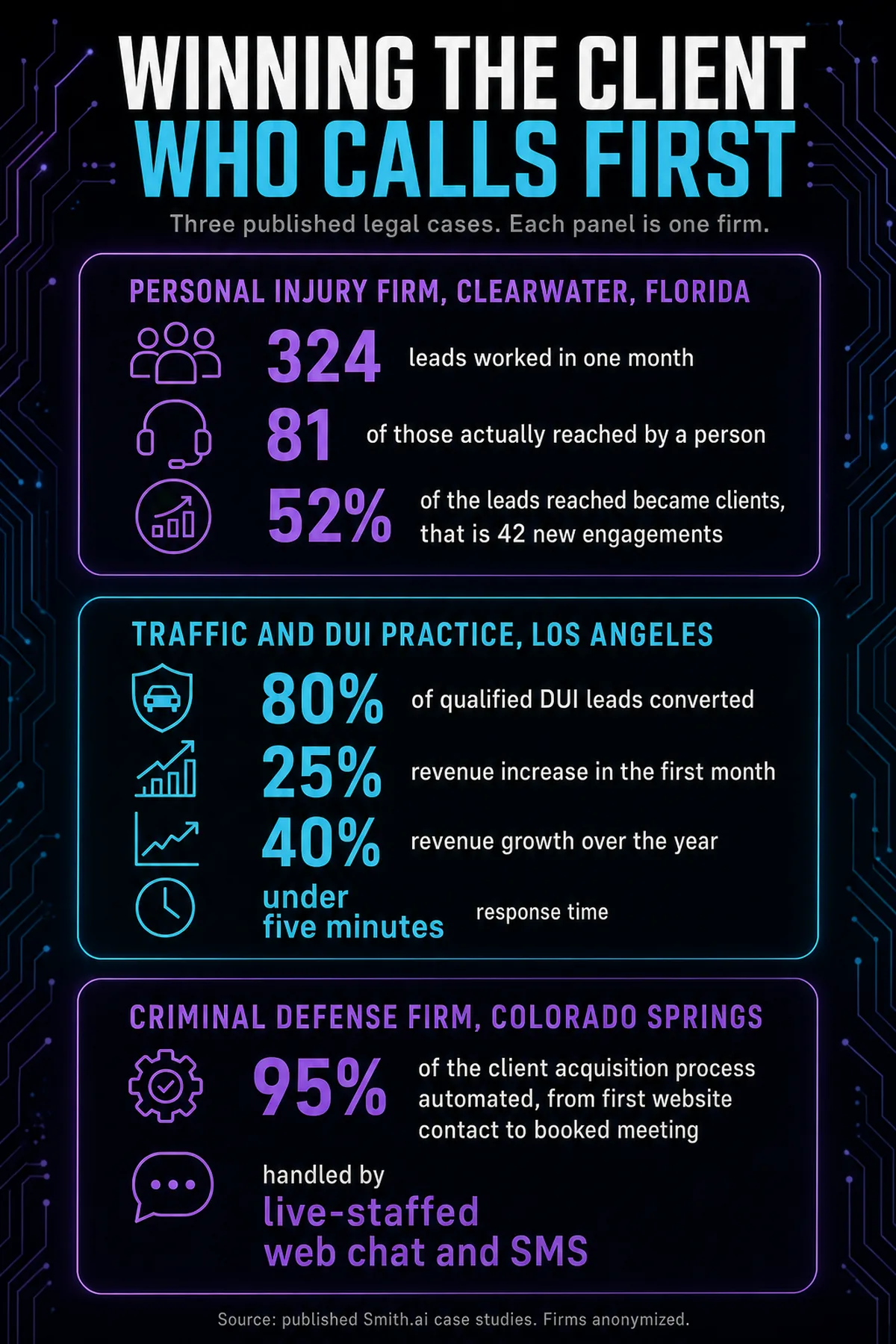
The team worked 324 leads in a month. Of the 81 it actually reached, it converted 52%, which is 42 of those 81 contacted, landing 42 new client engagements.
| What the published account reports | Detail |
|---|---|
| Leads worked in a month | 324 |
| Leads actually reached | 81 |
| Conversion on reached leads | 52% |
| New clients signed | 42 |
| Routing | Website form to calling team via Zapier |
| First outbound call | Within one week of onboarding |
| Staffing | Added one internal employee for the volume |
The 52% is the conversion rate on the leads the team reached rather than on all 324, and the distinction matters because plenty of forms never became a live conversation. The useful takeaway is that when a firm does reach a fresh lead fast, it wins about half of them.
What sales-trained calling and a virtual receptionist returned for an LA defense practice
Situation
A traffic and DUI defense practice in Los Angeles, California. The team spent too much of the day monitoring email inboxes, which hurt work-life balance, and the leads inside those inboxes were not engaged fast enough. The problem was not a lack of demand. It was how slowly the demand got attention.
A DUI arrest often happens late at night. The call comes when the office is dark, and by morning the caller has already retained someone who answered. A lead left until the next screen check is a case that goes to another firm.
What changed
The practice added sales-trained outbound calling plus a virtual receptionist for after-hours and overflow calls. The virtual receptionist covered the hours a small firm cannot staff with its own people, and the outbound calling made sure the leads already in hand got a real conversation.
The source text is unclear on how much of this was automated, so it does not support a clean "AI did this" claim. What the numbers do show is response speed and conversion. A live after-hours desk and an AI receptionist can both close that gap, and the case does not say which one did it here.
What it does tell you is that the same firm stopped treating the inbox as the intake desk. The response moved to a phone, it moved to the hours the clients actually call, and the result followed.
Results
The practice reports 80% conversion on qualified DUI leads. Revenue rose 25% in the first month and 40% over the year. Response times came in under five minutes.
| What the published account reports | Detail |
|---|---|
| Conversion on qualified DUI leads | 80% |
| Revenue, first month | up 25% |
| Revenue, over the year | up 40% |
| Response time | under five minutes |
| Coverage | Sales-trained calling plus a virtual receptionist |
| Hours covered | After-hours and overflow |
Under five minutes is the number that matters most, because an 80% conversion rate on qualified leads is only possible when the firm gets there first. The 25% and 40% are vendor-reported business outcomes rather than a receipt for one channel, since a firm can grow for several reasons at once. What stays consistent across the three cases is the speed.
How a Colorado Springs defense firm automated 95% of client acquisition
Situation
A criminal defense firm in Colorado Springs, Colorado. The firm was losing website inquiries that slipped through overnight. Someone filling out a contact form at 11pm got a response the next morning, if they got one at all. By then they had often hired someone else.
Overnight and weekend inquiries land on the same forms as every other one. A firm that works its forms only during business hours answers them the next morning, by which point the caller has already spoken to someone else.
What changed
The firm implemented live-staffed web chat plus SMS to capture and qualify leads around the clock. Chat agents gathered client intake details during the conversation, so a person who arrived at midnight left with their information captured and a next step, instead of a form no one would read until morning.
Be precise about the labels here, because they blur easily. This ran on live chat and SMS rather than voice. The chat was backed by AI technology but staffed by people, and nobody in this example describes a voice agent answering a phone line.
That distinction matters when you are shopping. If your leak is overnight phone calls, this case is about overnight text. The lesson transfers even though the exact product does not.
Results
The process of acquiring clients became 95% automated, from first contact on the website to securing an in-person meeting.
| What the published account reports | Detail |
|---|---|
| Client acquisition process | 95% automated |
| Channels | Live-staffed web chat plus SMS |
| Coverage | 24/7 capture and qualification |
| Intake | Chat agents gathered client details |
| Constraint | Text chat, not voice |
A 95% automation figure is a process number, not a staffing number and not a revenue number. It describes how much of the path from first touch to booked meeting ran without a person pushing each step. People still handled the conversations. The volume of steps the firm no longer did by hand is what the figure captures.
What the three legal cases prove about response time
Line the three up and the pattern is not subtle. A Clearwater firm signed 42 clients by calling form leads within a week of starting. An LA practice cut response time under five minutes and reported 80% conversion on qualified DUI leads. A Colorado Springs firm covered the overnight gap with text and made the path from first contact to a meeting 95% automated.
None of them won by having a better website. They won by being present when the lead was still warm. The tool changed from case to case, and so did the channel. The one constant is that somebody or something reached the lead first.
It is worth keeping the labels straight before copying anything from this. The Clearwater system is confirmed for speed rather than AI voice. The LA practice does not separate its automated work from its human work. The Colorado Springs firm ran chat and SMS with people on the other end. If a vendor waves one of these numbers at you to sell a different product, ask which case it actually came from.

Photo by Vitaly Gariev on Unsplash.
What to copy first
The cheapest win is time. Before you buy anything, measure how long a new web lead waits for a real conversation. Most firms do not know the answer, and the answer is usually worse than they guessed.
Copy in this order:
- Put a phone call behind every form. The Clearwater firm routed website submissions to callers through Zapier and made the first call within a week. You do not need a big build to start calling.
- Set a five-minute target. The LA practice hit under five minutes and reported 80% conversion on qualified leads. Even a same-day callback beats a next-morning email.
- Cover the closed hours. The Colorado Springs firm got 95% automation by handling overnight inquiries with chat and SMS. A separate after hours answering service covers the same gap for calls.
- Staff for the volume you want. The Clearwater firm had to hire for the extra work. Fast follow-up creates work, and you should plan for it.
- Keep the handoff clean. Intake details gathered on the first contact save the paralegal a second conversation later.
Then decide what stays human and what you automate. A legal answering service, a live virtual receptionist, or a voice system you run yourself can each hold the line, and the right choice depends on whether your leak is calls, texts, or forms. The pattern without a logo on it is respond first, capture the details cleanly, and book the meeting, which is the core of law firm intake.
If you want to build this
The first version is a rule and a person. Every new form, every missed call, gets a call back inside five minutes during business hours. Do that before you buy anything, because the Clearwater results came from timing more than from technology.
When the volume outgrows the manual version, watch the two layers separately. The first is the wiring. Make.com can watch for a new lead from your website or your phone system and push it to the right person or the system your intake team already opens, which is the same shape of routing the Clearwater firm set up through Zapier.
The second layer is who or what answers when nobody is on shift. Voice-agent platforms like Retell AI and Vapi are where most teams start when they want after-hours coverage without adding staff. That path is AI, and it is not what any of these three cases actually confirmed. Go in knowing that.
If you go the voice route, the voice itself decides whether a stressed caller stays on the line. A November 2025 Twilio blind test found 90% of consumers could not correctly identify an AI voice from a human one, though 72% believed they could tell. Neural voices from ElevenLabs are a large part of why that gap exists. You still need your intake questions, a rule for when a person takes over, and a check that nothing reads like legal advice.
Not sure which layer your firm needs? Book a free discovery call and we will map the leads you are losing to the response times that lost them, without pretending a chat tool and a voice agent are the same product.
The numbers in this article come from Smith.ai's published case studies: the Clearwater, Florida personal injury firm, the Los Angeles, California traffic and DUI defense practice, and the Colorado Springs, Colorado criminal defense firm. These are real anonymized case studies that show what voice AI does in practice. Some links in this post are affiliate links: if you sign up through them, we may earn a commission at no extra cost to you.
Frequently Asked Questions
Is this AI or people?
A mix, labeled example by example. The Clearwater personal injury firm ran a speed-to-lead calling system, and the source does not confirm the voice was AI. The Los Angeles traffic and DUI practice combined outbound calling with a virtual receptionist, and the source does not separate automated from human effort. The Colorado Springs criminal defense firm ran live web chat and SMS, backed by AI technology but staffed by people. None of the three proves a specific AI product did the work.
What is speed to lead?
Speed to lead is how fast a firm responds after someone raises a hand, the time between a lead arriving and the first real contact. In legal, that window is short. A person with an arrest or an injury is calling several firms, and the one that reaches them first usually gets the signed engagement. Slow follow-up hands the client to a competitor who simply answered sooner.
Does AI answer the phone here?
Not in the examples as published. The Clearwater firm's system is confirmed for timing, not for voice. The Los Angeles practice ran human-led calling plus a virtual receptionist. The Colorado Springs firm used live chat and SMS where people handled the conversations. What all three prove is response speed. Whether voice AI sits on the line is a separate question the sources do not answer.
What should a law firm fix first?
Fix the response time before you buy software. Every form submission and missed call should get a human touch inside five minutes, on a phone, not just an email. That single change captures most of the value in these three cases. After that, cover the hours your office is closed, because the Colorado Springs story is exactly about overnight inquiries slipping away.
Where do these numbers come from?
Every figure comes from Smith.ai's published case studies, not from a Nebula AI measurement. Smith.ai published the Clearwater personal injury firm, the Los Angeles traffic and DUI practice, and the Colorado Springs criminal defense firm. These are real anonymized case studies that show what voice AI does in practice. The 52%, the 25% and 40% revenue figures, and the 95% automation figure are vendor-reported business outcomes, not independent audits.
Founder of Nebula AI. Builds AIOS for established businesses.
Get one practical AI idea for your business, once a month.
Put this to work in your business
Not sure where your phone calls are leaking?
Book a free discovery call and we will map the calls you are missing to the jobs they should have been. Half an hour, no pitch deck.
 Case Study15 min read
Voice AI for Banking: 4 Published Results on Calls
A Swiss bank cut call processing time about 20%. A US credit union reports 66% of calls automated. Four published banking cases on routine calls and waits.
 Case Study13 min read
AI Calls for Admissions and Agencies: 4 Real Results
An online school saved advisors 100,000+ minutes a month. A studio lifted leads 50% by answering every call. Four published cases on admissions and agencies.