


Voice AI for Banking: 4 Published Results on Calls
A Swiss bank cut call processing time about 20%. A US credit union reports 66% of calls automated. Four published banking cases on routine calls and waits.
John Park, Founder, Nebula AI15 min read
- Can voice AI for banking take routine calls off your advisors?
- What a voice assistant and voice biometrics did for a Swiss retail bank
- How voice biometrics let a Swiss financial institution automate document orders
- How a credit union used voice AI to get its lending team back
- What voice AI did for a credit union whose phone banking system was being retired
- What the four banking cases prove about calls, identity and waits
- What to copy first
- If you want to build this
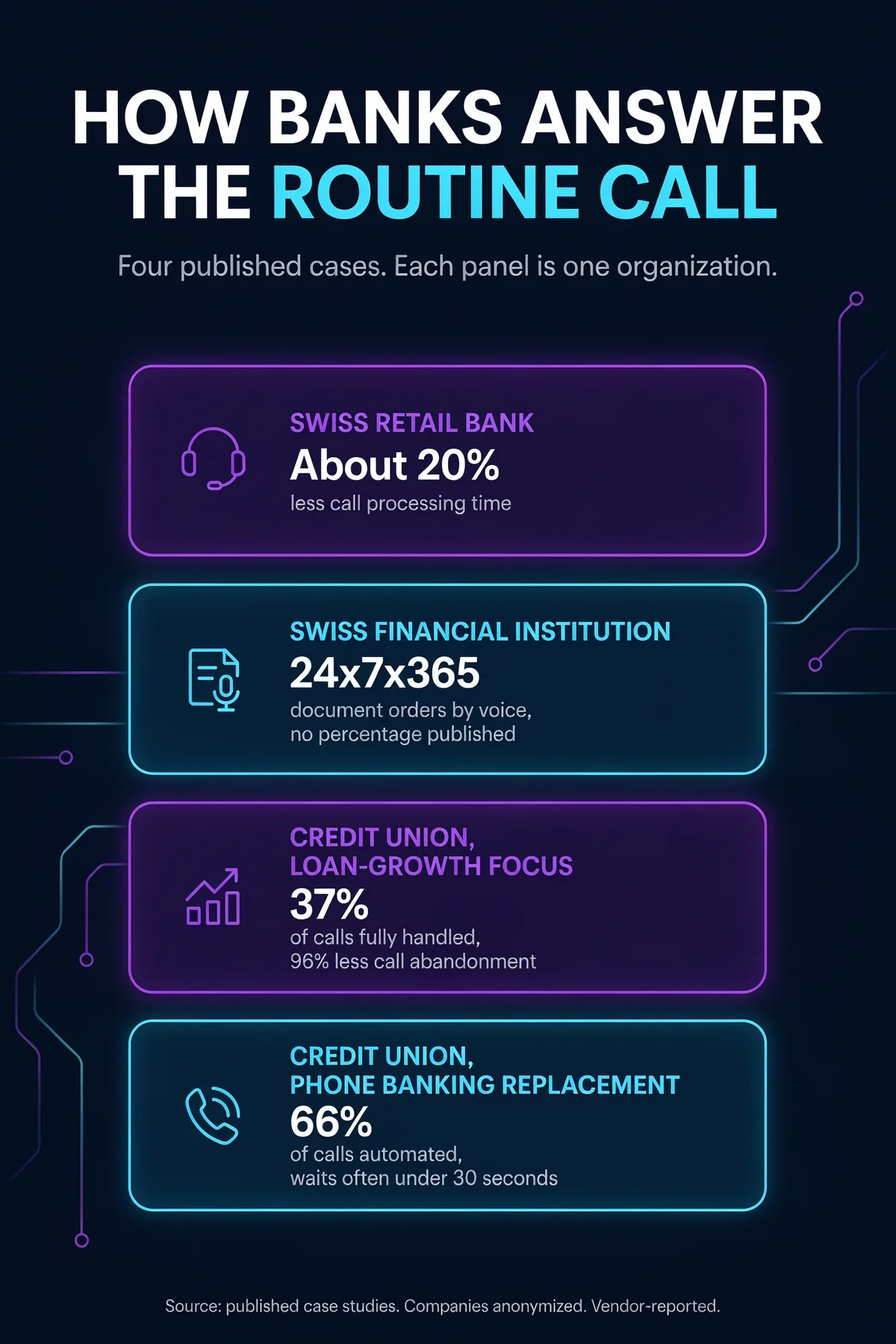
The short version: Voice AI for banking works when it takes the routine call and leaves the hard one to a person. A US credit union reports 66% of its incoming calls automated, a second fully handled 37%, and a Swiss bank cut average call processing time about 20% by authenticating callers by voice.
Every bank call is really two calls. One is the question, and the other is proving the caller is who they say they are.
The second one is where the time goes. At a Swiss bank, callers used to answer security questions before the real question could start. At two US credit unions, callers navigated phone menus and waited in queues. None of that is the member's actual problem. It is friction in front of the problem.
Four published examples follow of voice AI for banking, all from vendors' own case studies. The institutions are anonymized and the sources stay named, so every number can be checked: a Swiss retail bank, a Swiss retail financial institution, and two US credit unions. A wider set of results across industries sits in a roundup of real voice and answering outcomes.
Can voice AI for banking take routine calls off your advisors?
Yes, for the routine ones. In the published cases, one credit union automated 66% of its incoming calls and another fully handled 37%, while a Swiss bank cut call processing time about 20% by authenticating callers by voice. Calls that need judgment, or a verified person, still reach staff.
That is a narrower claim than "AI runs the call center," and it is the one these cases support. In all four, the assistant takes the repeatable call and a person keeps the rest.
The cases also solve different problems. One bank wanted to stop asking security questions. One credit union wanted its lending team back. One wanted a replacement for a phone system that was being shut off. Same technology, three different reasons to buy it.
What a voice assistant and voice biometrics did for a Swiss retail bank
Situation
A Swiss retail bank whose customer center of 190 advisors took 650,000 calls in 2022 alone. Without technical help, that many calls could only be handled with waiting times for the callers. The bank was also authenticating callers with security questions, the knowledge-based kind, which slow every call before the real question begins.
What changed
The bank added voice biometrics that run in the background through the whole conversation, authenticating the caller after a few seconds of free speech. A virtual assistant recognizes what the caller needs and refers them to the right service point. It also handles queries on its own around the clock: texting a link to the right page of the bank's site, unlocking e-banking access devices, and sending new activation codes. It works in German, Swiss German dialects, Italian, and French.
This is an AI voice assistant with voice biometrics, in front of a human customer center.
Results
Per the published case study, average call processing time was cut by about 20%. The bank also says customer satisfaction grew because security questions are gone, and the voice bot placed on the podium of an industry bot award.
| What the published account reports | Detail |
|---|---|
| Average call processing time | Cut about 20% |
| Calls to the customer center, 2022 | 650,000 |
| Advisors | 190 |
| Languages | German, Swiss German dialects, Italian, French |
| Availability | 24/7 self-service |
| Satisfaction | Reported as improved, no figure given |
The 20% is time per call, not calls avoided, and it comes from the assistant and the biometrics together. The satisfaction claim has no number behind it, so treat it as the vendor's reading. The takeaway is a different win from automating calls away: less time on every call that still reaches a person.
How voice biometrics let a Swiss financial institution automate document orders
Situation
A Swiss retail financial institution where simple, essential services such as ordering documents were only available during business hours. Routine requests kept agents from focusing on the more complex issues that needed them.
What changed
Customers now order documents by voice. The assistant greets the caller, asks for personal details, and verifies the caller by voice biometrics in a few seconds. It recognizes what the caller wants, walks them through the order in natural conversation, and executes it, arranging delivery to the home address. In a 2020 pilot described on the institution's own blog, customers who had registered a voiceprint could order account statements and interest statements by phone in German, for private and savings accounts. The bot understood Swiss German, and the team described it as groundbreaking work for financial services, with no comparable project to draw on.
This is an AI voice assistant with voice biometrics, completing a transaction from start to finish.
Results
Per the published case study, the service is available 24x7x365, no requests are missed, and callers do not wait on the line. Average handling time for document orders was "considerably reduced". No percentage is published.
| What the published account reports | Detail |
|---|---|
| Availability | 24x7x365 |
| Missed requests | None reported |
| Average handling time | "Considerably reduced", no figure |
| Task automated | Document orders, end to end |
| Verification | Voice biometrics, in seconds |
| Growth effect | No need to regularly add and train contact center operators |
This is the thinnest panel on numbers, and it stays in because of what it automates. A document order is a transaction, not a question. The case is that a bank can let a customer finish the whole job by voice at 3am, and the institution says it can grow without hiring and training more operators. How much it saved, the source does not say.
How a credit union used voice AI to get its lending team back
Situation
A US credit union with a digital team built to drive loan growth. In practice that team was stuck covering overflow phones. An aging phone system with an outdated menu sent callers on long routes, offered no voice self-service, and gave no after-hours phone support. When a call transferred, agents did not know why the member was calling.
That had a cost beyond the phones. Loan applicants waited too long and had time to shop around, in-branch staff were pulled away from members standing in front of them to answer loan questions, and the team meant to grow lending spent its day answering routine calls.
What changed
The credit union replaced its menu with a voice AI agent that acts as the first line for every call, automating routine inquiries around the clock. The vendor says it is built to handle more than 900 banking journeys. AI routing sends members to the right agent faster, a transfer summary gives the agent context, and a post-call tool writes up the interaction so the agent does not have to.
This is an AI voice agent replacing a phone menu, with agent-assist tools behind it.
Results
The assistant answered 100% of calls at all hours and fully handled 37% with no agent. The credit union reports call abandonment down 96% and average wait time down 91%. It also reports 15% fewer calls handled by agents each month, and 69 agent hours a week saved.
| What the published account reports | Detail |
|---|---|
| Calls answered, all hours | 100% |
| Calls fully handled with no agent | 37% |
| Call abandonment rate | Down 96% |
| Average wait time | Down 91% |
| Monthly calls handled by agents | Down 15% |
| Post-call work | Down 40%, 33 hours of agent work a month |
| Agent time saved | 69 hours a week |
| Loan dollars from the digital center | Up 21% through the first half of 2025 |
Three limits apply. The page gives no starting abandonment rate, no starting wait time, and no timeframe for the 96% and 91%, so those are percentages of unknown baselines. The 37% and the 15% are different measures. One is the share of calls the assistant finished, and the other is the drop in calls reaching agents. And the 21% is a vendor-reported figure that the page ties to freed staff time without separating it from other changes.
What stands out is where the time went. The credit union grew its digital loan team with the hours it saved instead of banking them, and reports that the digital center led its retail branches in loan growth and volume.
What voice AI did for a credit union whose phone banking system was being retired
Situation
A US credit union whose automated phone banking system was being discontinued. The old system took 20,000 to 25,000 calls a month, and the credit union could not afford to push those calls onto its agents. It already had high call volume and high staff turnover, and its agents were burning out on repetitive calls.
That is a vicious cycle. When an agent leaves, the remaining team carries a heavier load, and the next agent leaves sooner.
What changed
The credit union replaced the system with a voice AI agent, rolled out in phases. The first phase covered the most frequent requests, such as balance checks, transfers, and account information. API integrations later let the assistant handle loan payments and password resets. On the website it chose chat AI over live chat, and the chat assistant directs members to the phone when a query is complex or needs multi-factor authentication, because those queries tend to need a call anyway.
This is an AI voice agent replacing an automated phone system, plus a chat assistant that hands off to the phone.
Results
The vendor reports 66% of incoming calls automated. Members who used to wait 20 to 30 minutes for an agent now often wait under 30 seconds, and peak waits rarely exceed two to four minutes. The credit union reports $800,000 saved in one year and a stable team of 17 agents.
| What the published account reports | Detail |
|---|---|
| Incoming calls automated | 66% |
| Old phone banking volume | 20,000 to 25,000 calls a month |
| Member wait for an agent, before | 20 to 30 minutes |
| Member wait for an agent, now | Often under 30 seconds |
| Peak waits | Rarely above 2 to 4 minutes |
| After-hours calls handled, December 2024 | 9,000+ |
| Savings in one year | Over $800,000 |
The page does not define "automated," and a quoted executive describes it as "over 60%" of queries, so treat 66% as a vendor-reported round figure. It does not itemize the $800,000, which it attributes to avoided staffing and efficiency. Its headline results also state the after-hours number as a monthly figure while the text ties it to December 2024. And the page calls wait times "dramatically reduced" without a measured before and after for the same period.
The point is easy to miss. A credit union that automated two thirds of its calls kept a stable team of 17 agents and did not need to grow it.
What the four banking cases prove about calls, identity and waits
Three different kinds of number run through these cases. A Swiss bank cut about 20% of processing time per call. A US credit union fully handled 37% of calls and reports far less abandonment and waiting. Another automated 66% of incoming calls and shortened member waits from 20 to 30 minutes to often under 30 seconds. The Swiss institution let customers finish a document order at any hour.
None of them won by replacing the advisor. They won by deciding who or what handles the routine part of the call, and by making identity cheaper to prove.
These figures get mistaken for each other, so keep them apart. The Swiss 20% is less processing time per call, and it belongs to the assistant and the biometrics together. The first credit union's 37% is calls finished with no agent at all. The second credit union's 66% is a share of calls automated that its page never defines. The first credit union's abandonment and wait cuts sit on baselines it never published. When a vendor quotes one of these to sell you something else, ask which case it came from.
Photo by CardMapr.nl on Unsplash.
What to copy first
Start with the phone menu, not the AI. Both credit unions began with an old menu or phone system that sent callers around before anyone helped them.
Copy in this order:
- Measure abandonment and wait time before you measure containment. The first credit union reports abandonment and wait first, and the second reports waits that fell from 20 to 30 minutes to under 30 seconds. A bank can automate 60% of calls and still leave members waiting.
- Replace the menu with one assistant that answers every call. Both credit unions put the assistant in front of every call and moved agents to the calls that needed them.
- Start with the most frequent requests. The second credit union began with balance checks, transfers, and account information, and added loan payments and password resets later.
- Remove friction from identity. The Swiss bank replaced security questions with voice biometrics that authenticate in the background, and the second credit union sent queries needing multi-factor authentication to a phone agent instead of chat.
- Give the agent context at transfer. The first credit union's transfer summary means agents do not start by asking why the member called.
- Decide where the freed hours go before you launch. One credit union grew its loan team with the time it saved, and the other held a stable team of 17 agents instead of hiring.
After that, the shape of the fix is the same at any size: answer the routine call, prove identity once and cheaply, and hand off with context.
If you want to build this
Start with a pen and last month's call log. Mark every call that only needed a fact: a balance, a statement, an address change. Give each marked call a two-line answer, and put one person in charge of keeping those answers true. That document is the project, before any software.
Automation comes in two steps. Wiring first: Make.com hands a call's details to the screen your agent already has open, so nobody repeats their account number twice.
Then the voice. Retell AI and Vapi are the usual starting platforms. Voice quality is what keeps a caller on the line: a November 2025 Twilio blind test found 90% of consumers could not tell an AI voice from a human one, though 72% thought they could, and neural voices from ElevenLabs are much of the reason.
Banking adds a step the other industries do not have: identity. Whatever you automate, your compliance team owns the consent language and the authentication method before the first real call. Voice biometrics can replace security questions, but the rule for when a person takes over is not optional.
If the front desk is the part you want off your plate, an AI receptionist is one of the digital employees we build, and the comparison with an answering service covers the same ground at small-business scale.
Book a free discovery call if you want your call types sorted into the ones software can take and the ones where a balance check and a loan question are genuinely different calls.
The numbers in this article come from each provider's published case study: Spitch's bank case study, Spitch's financial institution case study with the institution's own 2020 blog post, Glia's credit union case study, and interface.ai's credit union case study. These are real anonymized case studies that show what voice AI can do in practice. Some links in this post are affiliate links: if you sign up through them, we may earn a commission at no extra cost to you.
Frequently Asked Questions
Does voice biometrics replace security questions?
For one Swiss bank it did. The bank had used security questions and moved to voice biometrics that authenticate the caller in the background after a few seconds of normal speech. It reports average call processing time cut by about 20%, from the assistant and the biometrics together. A second Swiss institution verifies callers by voice before they order documents. Both are vendor-published results.
What share of bank calls can voice AI handle?
It depends on the institution and on how the vendor counts. One US credit union reports 37% of calls fully handled with no agent. Another reports 66% of incoming calls automated, a vendor-reported figure the page does not define. A Swiss bank reports no automation share, only about 20% less processing time per call. Those are three different measures, so do not compare them directly.
Can voice AI help a credit union grow loans?
One credit union reports a 21% increase in loan dollars from its digital center through the first half of 2025. The case study ties that to staff time freed from routine calls, which let the team stop covering overflow phones and focus on lending. The page does not isolate the effect of the phone assistant from other changes, so treat the 21% as vendor-reported and directional.
Is voice AI for banking only for big banks?
No. Two of the four cases are credit unions, and one reports a stable team of 17 agents after automating 66% of calls. The Swiss bank is larger, with 190 advisors and 650,000 calls in a year. The pattern scales down: automate the routine call, verify identity only when the call needs it, and keep a person for the rest. None of the cases publish costs.
Where do these numbers come from?
Every figure comes from a vendor's published case study, not from a Nebula AI measurement. Spitch published the Swiss bank and financial institution, Glia the first credit union, and interface.ai the second. These are real anonymized case studies that show what voice AI can do in practice. All results are vendor-reported business outcomes, not independent audits.
Founder of Nebula AI. Builds AIOS for established businesses.
Get one practical AI idea for your business, once a month.
Put this to work in your business
Not sure where your phone calls are leaking?
Book a free discovery call and we will map the calls you are missing to the jobs they should have been. Half an hour, no pitch deck.
 Case Study13 min read
AI Calls for Admissions and Agencies: 4 Real Results
An online school saved advisors 100,000+ minutes a month. A studio lifted leads 50% by answering every call. Four published cases on admissions and agencies.
 Case Study12 min read
AI Receptionist for Restaurants: 4 Published Results
A restaurant group booked 3,598 reservations in a year. A drive-thru chain reports 90%+ order completion. Four published cases on answering every call.