

AI Receptionist for Restaurants: 4 Published Results
A restaurant group booked 3,598 reservations in a year. A drive-thru chain reports 90%+ order completion. Four published cases on answering every call.
John Park, Founder, Nebula AI12 min read
- Can an AI receptionist for restaurants handle the phone during service?
- What AI phone answering did for a Miami restaurant group
- How a plant-based restaurant group had AI fully handle half its calls
- What a phone assistant did for a single-location brewpub
- What a voice assistant did for a burger chain's drive-thru
- What the four restaurant cases prove about answering during service
- What to copy first
- If you want to build this
The short version: An AI receptionist for restaurants answers the phone while the host is busy with a guest. A plant-based restaurant group had AI fully handle 50% of its 87,578 calls in a year, and a Miami group reports 96% caller satisfaction. The pattern holds from a single brewpub to a drive-thru lane.
Every busy restaurant makes the same bad trade. The host can answer the phone or greet the guest standing at the door, and the guest at the door wins every time.
So the phone loses, and nobody counts the loss. A caller who gets no answer rarely leaves a voicemail. They call the next place on the list. The reservation never shows up as a missed sale anywhere, it just shows up as a table that stayed empty.
Four published examples follow, all from vendors' own case studies. The companies are anonymized and the sources stay named, so every number can be checked: a restaurant group in Miami, a plant-based restaurant group across North America, a single brewpub in Illinois, and a burger chain with a drive-thru lane. A wider set of results across industries sits in a roundup of real voice and answering outcomes.
Can an AI receptionist for restaurants handle the phone during service?
Yes, for the routine calls. One restaurant group had AI fully handle 50% of its calls, another had it handle 60%, and both booked reservations straight into their booking system. Calls that need judgment still go to staff. The gain is that the host stops choosing between the phone and the guest at the door.
That is a narrower claim than "AI runs your phones," and it is the one the cases support. In every example the assistant takes the repeatable calls and hands the rest to a person.
The phone is also data most restaurants never see. One group in this post ran a phone line that rang all day, with no voicemail and no record of how many calls it answered. You cannot fix an answer rate you have never measured.
What AI phone answering did for a Miami restaurant group
Situation
A group of full-service restaurants in Miami, Florida. At its busiest location, hundreds of calls a day were more than the staff could take, and the group says it could not give a caller a good experience. On top of that, it describes a Miami habit of booking two tables and keeping one: on any given night, about a third of reservations are canceled or never show.
A host cannot hold a phone to one ear and seat a party of six with the other hand. Something gave, and it was usually the phone.
What changed
The group tested an AI phone assistant at one restaurant, saw strong results, and rolled it out to all its locations. The assistant was connected to the group's reservation platform, so a caller could book, change, or cancel a table in the same call. A person had been stationed upstairs just to handle reservations. That role moved to front-of-house work.
This is an AI voice assistant answering the restaurant's own phone line, with the reservation platform behind it.
Results
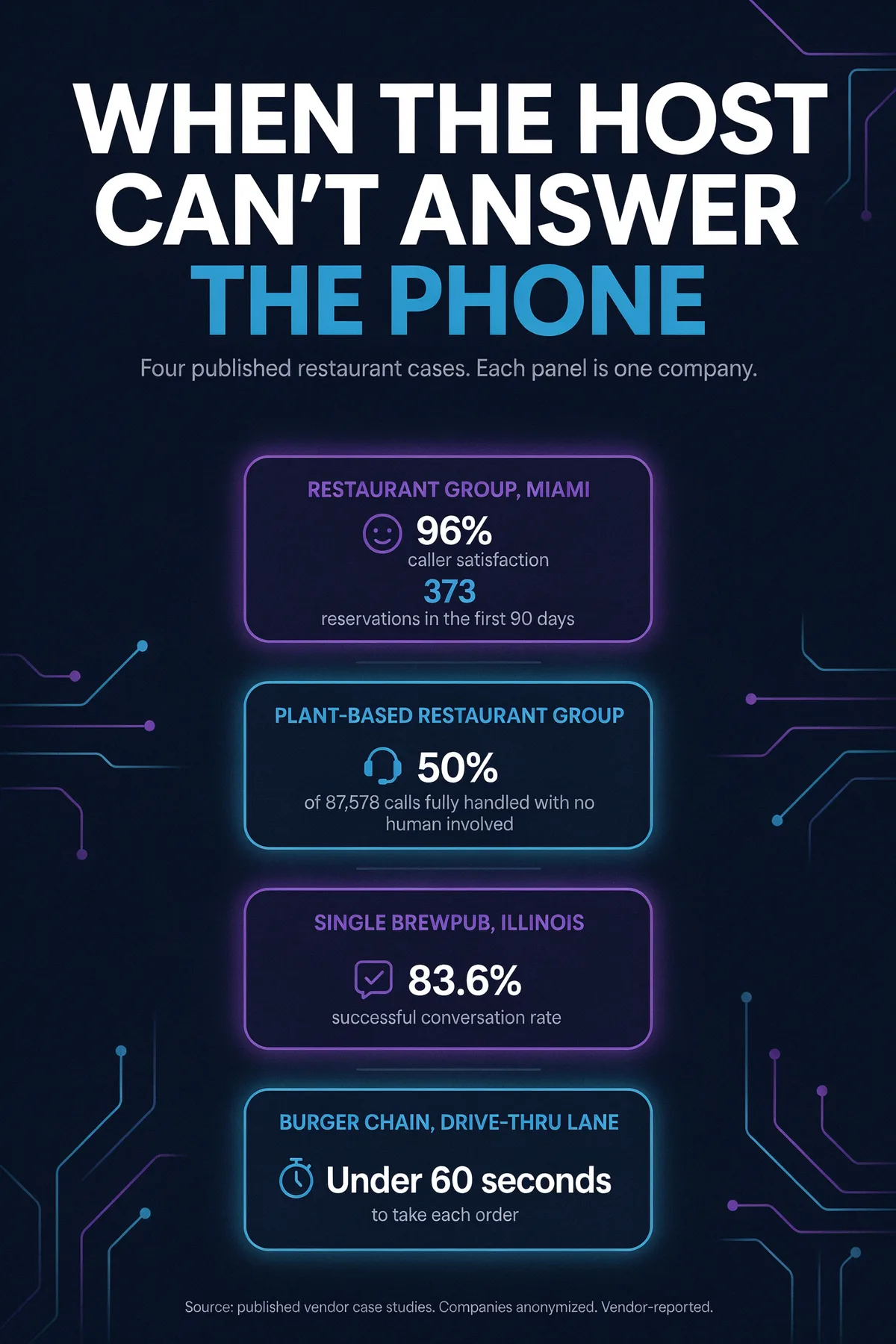
In the first 90 days the assistant handled 60% of calls and reached 96% caller satisfaction. The reservation integration secured 373 reservations over the same period.
| What the published account reports | Detail |
|---|---|
| Calls handled by the assistant | 60% |
| Caller satisfaction (CSAT) | 96% |
| Reservations secured through the integration | 373 |
| Period | First 90 days |
| Rollout | One restaurant first, then all locations |
| Staffing | One reservations role redeployed to front-of-house |
The 60% is a share of calls, not a share of tables booked. The 96% comes from the vendor's caller survey, and the page does not say how many callers answered it. What the numbers do show is a group that stopped treating the phone as something the host squeezes in.
How a plant-based restaurant group had AI fully handle half its calls
Situation
A plant-based restaurant group with locations across North America. Front-of-house staff made small decisions all night, and one of them was whether to answer the phone or tend to the guest in front of them. The group did have a phone system. It had no voicemail and no view of its own answer rate, so the phone just rang all day.
The group also had the labor squeeze common to the industry, and it wanted to measure its phones the way it measured everything else.
What changed
The group started with two locations and moved to all of them once it saw efficiency gains. The assistant answers in a hospitality-first way and books reservations directly. It also reports call volume and what people are calling about, which the old system could not do.
This is an AI voice assistant on the phone line, with reporting built in.
Results
Over the last year the assistant answered 87,578 calls and fully handled 50% of them without human intervention. It booked 3,598 reservations in the same year.
| What the published account reports | Detail |
|---|---|
| Calls answered, last year | 87,578 |
| Calls fully handled with no human involved | 50% |
| Reservations booked, last year | 3,598 |
| Rollout | Two-location pilot, then every location |
| New visibility | Call volume and call topics |
Put the two big numbers side by side. Reservations came to 3,598 against 87,578 calls, so most calls did not end in a booked table. That is why the half of calls the assistant fully handled matters more than the reservation count. The group can now see what those other calls are about, which is the data its old phone line never gave it.
What a phone assistant did for a single-location brewpub
Situation
A single-location brewpub in Illinois that takes takeout orders and private-event bookings by phone. The phone was answered by whoever was free, and when everyone was busy it forwarded to the manager's office. That meant missed calls, piled-up voicemails, and lost orders and event bookings.
What changed
The brewpub put an AI phone concierge on its line. Staff now answer the phone a fraction of the time they used to, and the general manager says the assistant almost completely eliminated the robocalls and junk calls that used to tie up the line.
This is an AI voice assistant on the restaurant's phone line, at the smallest scale in this post.
Results
After 60 days the brewpub reports an 83.6% successful conversation rate, 85.7% caller satisfaction, and $774 in labor savings. The case study is headlined with 43 hours of labor saved.
| What the published account reports | Detail |
|---|---|
| Successful conversation rate | 83.6% |
| Caller satisfaction | 85.7% |
| Labor saved (headline figure) | 43 hours |
| Labor cost saved, first 60 days | $774 |
| Basis for the dollar figure | Illinois minimum wage, per the vendor |
The page does not show how 43 hours becomes $774, so read the dollar figure as an estimate. It is also small, and that is the honest part. A single location saves a few hundred dollars of labor, not a payroll. The case for it is the order and the event booking that no longer ring out during a rush.
What a voice assistant did for a burger chain's drive-thru
Situation
A quick-service burger chain with drive-thru lanes. Staffing shortages meant team members covered several jobs on top of the register, and the chain wanted more capacity, higher order accuracy, and more time for staff to talk to customers.
What changed
The chain put a custom AI voice assistant on the drive-thru. It speaks the moment a car pulls up and takes the order by voice. The order goes straight to the point of sale and the kitchen display, and customers see their order on a screen. The employee who used to take the order now greets people at the pickup window.
This is voice AI in the drive-thru lane, not on a phone line.
Results
The vendor reports each order is taken in under 60 seconds, with an order completion rate of over 90%.
| What the published account reports | Detail |
|---|---|
| Time to take an order | Under 60 seconds |
| Order completion rate | Over 90% |
| Order path | Straight to the point of sale and kitchen display |
| Vendor claim: upselling | Offered 100% of the time, against an industry standard the vendor puts at 42% |
Two limits apply. The case study does not define "order completion," so do not read it as order accuracy. It also gives no accuracy percentage, which means "improved accuracy" is a claim without a number. The upselling comparison is the vendor's pitch, and the 42% figure is not sourced.
What the four restaurant cases prove about answering during service
Line them up. Three restaurants got the phone covered while staff stayed with guests: a Miami group at 60% of calls handled, a plant-based group at 50% fully handled, and a brewpub at an 83.6% successful conversation rate. The fourth took drive-thru orders in under 60 seconds.
None of them won by replacing the host. They won by taking the repetitive part of the phone away from the host, and by measuring it for the first time.
All four are AI, and they are not the same job. Three answer phone calls. One takes drive-thru orders from cars. If a vendor waves the 90% drive-thru number at you to sell a reservation line, ask which case it came from.
Photo by Negley Stockman on Unsplash.
What to copy first
Start by finding out how many calls you miss. One group in this post had no idea until the assistant started reporting call volume and topics. Most restaurants are in the same position.
Copy in this order:
- Measure your answer rate for a week. Count calls and unanswered calls, even by hand. The plant-based group started with no visibility at all.
- Pilot at one or two locations. The Miami group began at one restaurant, and the plant-based group began at two.
- Connect the booking system. The Miami group's 373 reservations came through its reservation platform integration, not a message left on a machine.
- Count the hours you get back. The Miami group redeployed a reservations role and the brewpub tracked 43 hours of labor. If you cannot say where the hours went, you cannot judge the tool.
- Decide what a person still takes. Half of the plant-based group's calls were not fully handled by the assistant, and neither were 40% of the Miami group's. That is how it should work.
The pattern without a logo on it is the same each time: answer the call, capture what the guest wants, book it into the system you already run, and hand off what needs a person.
If you want to build this
The first version is a rule and a person. Pick whoever is on the floor with the least to do each shift and make the phone theirs, then log every call you miss for a week. Do that before you buy anything.
When the missed-call list is long enough to justify software, there are two layers. The first is the wiring. Make.com can watch for a missed call or a new booking and push it to the person or system your team already checks.
The second is who answers when nobody is free. Voice-agent platforms like Retell AI and Vapi are where most teams start.
If you go the voice route, the voice decides whether a hungry caller stays on the line. A November 2025 Twilio blind test found 90% of consumers could not correctly identify an AI voice from a human one, though 72% believed they could tell. Neural voices from ElevenLabs are a large part of why that gap exists. You still need your menu answers, a rule for when a person takes over, and a check that the assistant never promises a table the system cannot give.
The same front-desk problem shows up for service businesses, covered in voice AI for home services. An AI receptionist is also one of the digital employees we build.
Not sure how many calls your restaurant is missing? Book a free discovery call and we will map the calls you lose to the tables they should have filled, without pretending a phone line and a drive-thru lane are the same product.
The numbers in this article come from each provider's published case study: Slang's Miami restaurant group story, Slang's plant-based restaurant group story, and Slang's Illinois brewpub story, and SoundHound's drive-thru case study for the burger chain. These are real anonymized case studies that show what voice AI can do in practice. Some links in this post are affiliate links: if you sign up through them, we may earn a commission at no extra cost to you.
Frequently Asked Questions
Can AI take restaurant reservations over the phone?
Yes, in two of the four cases. A Miami restaurant group connected its AI phone assistant to its reservation platform and secured 373 reservations in the first 90 days. A plant-based restaurant group reports 3,598 reservations booked in a year. Both figures are vendor-reported, and the assistant only books what the reservation system already allows.
How many restaurant calls can AI handle without a person?
It depends on the restaurant and on how the vendor counts. The plant-based group reports 50% of 87,578 calls fully handled with no human involved. The Miami group reports 60% of calls handled. The brewpub reports an 83.6% successful conversation rate, a vendor-defined measure. Expect the rest to reach staff, which is the design.
Does AI phone answering work for a single restaurant?
It worked for one brewpub in Illinois, with modest numbers: 43 hours of labor and $774 saved in the first 60 days, per the vendor. The page does not show how the hours became dollars, so treat the dollar figure as an estimate. The larger value for a single location is the calls that no longer ring out during a rush.
Is the drive-thru case the same thing as phone AI?
No. The burger chain used a voice assistant in the drive-thru lane, taking orders from cars, not answering a phone line. Its numbers, an order taken in under 60 seconds and over 90% order completion, do not transfer to a reservation line. A vendor who uses one to sell the other is mixing two products.
Where do these numbers come from?
Every figure comes from a vendor's published case study, not from a Nebula AI measurement. Slang published the three restaurant groups and SoundHound published the drive-thru chain. These are real anonymized case studies that show what voice AI can do in practice. All results are vendor-reported business outcomes, not independent audits.
Founder of Nebula AI. Builds AIOS for established businesses.
Get one practical AI idea for your business, once a month.
Put this to work in your business
Not sure where your phone calls are leaking?
Book a free discovery call and we will map the calls you are missing to the jobs they should have been. Half an hour, no pitch deck.
 Case Study15 min read
Voice AI for Banking: 4 Published Results on Calls
A Swiss bank cut call processing time about 20%. A US credit union reports 66% of calls automated. Four published banking cases on routine calls and waits.
 Case Study13 min read
AI Calls for Admissions and Agencies: 4 Real Results
An online school saved advisors 100,000+ minutes a month. A studio lifted leads 50% by answering every call. Four published cases on admissions and agencies.