


Voice AI for Utilities and Public Services: 3 Real Cases
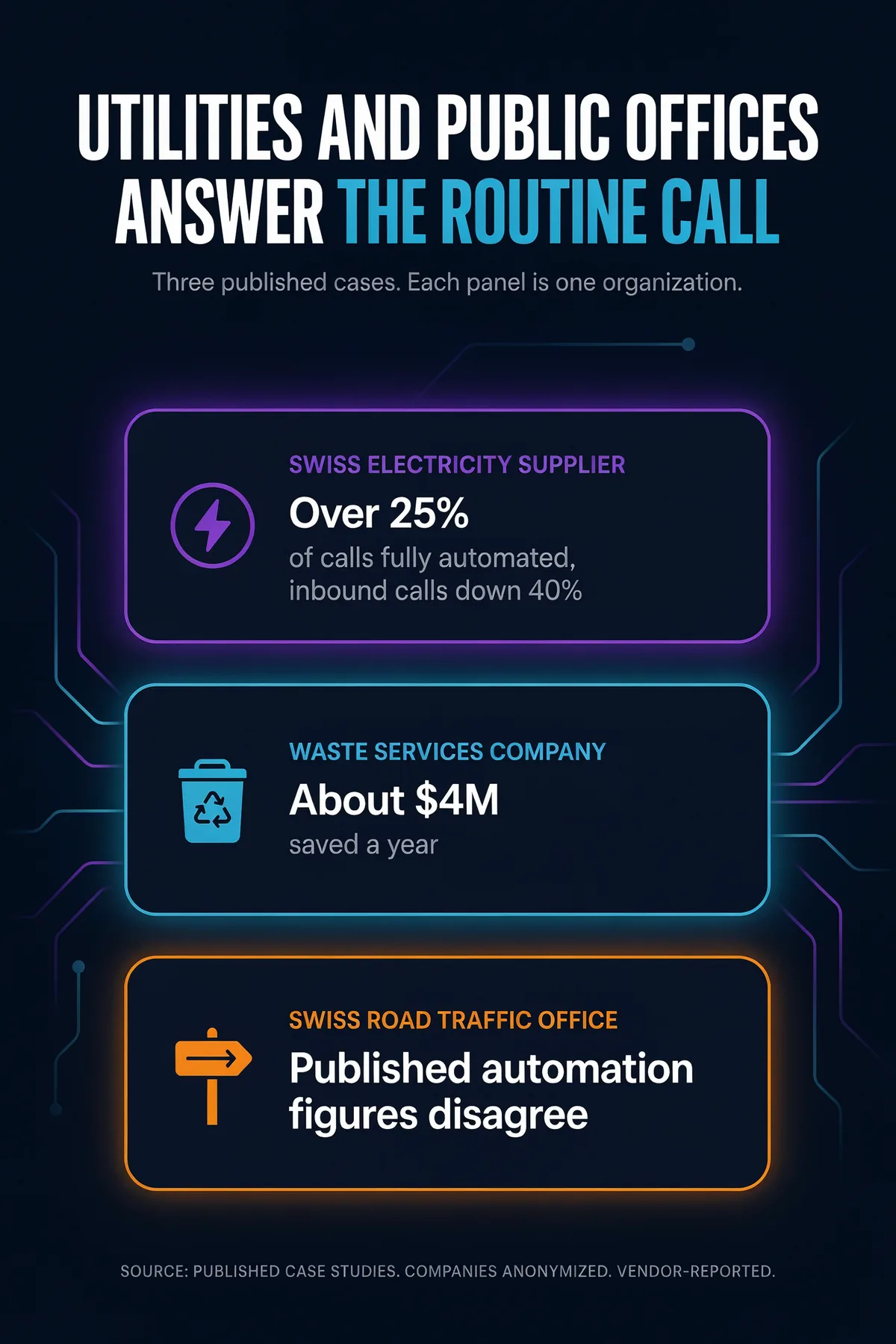
A Swiss utility fully automated over 25% of its calls. A waste company reports about $4M saved a year. Three published cases on utilities and public services.
John Park, Founder, Nebula AI12 min read
- Does voice AI for utilities work for routine customer calls?
- How a voice assistant fully automated 25% of calls for a Swiss electricity supplier
- How a waste company's AI agent automated service for 250K+ users a month
- What a voice bot did for a Swiss cantonal road traffic office, and why its numbers disagree
- What the three cases prove about utilities and public services
- What to copy first
- If you want to build this
The short version: Voice AI for utilities works on the calls that have a known answer. A Swiss electricity supplier fully automated more than 25% of its calls, a waste company reports about $4M saved a year, and a road traffic office built its bot on public information only.
Nobody calls a utility to chat. They call because the pickup was missed, the bill looks wrong, or the office closed an hour ago and something needs an answer tonight.
Many of those calls have a known answer, and the people who take them can only work the hours the office is open. That is the arithmetic every utility and public office lives with.
Three published examples follow, from vendors' and organizations' own pages. The organizations are anonymized and the sources stay named, so every number can be checked: a regional Swiss electricity supplier, a waste services company in the United States and Canada, and a Swiss cantonal road traffic office. A wider set of results across industries sits in a roundup of real voice and answering outcomes.
Does voice AI for utilities work for routine customer calls?
Yes, for the routine ones. In the published cases, a voice assistant fully automated over 25% of a Swiss utility's calls, and an after-hours voice bot took a waste company's routine requests when agents were off. People still take the complex calls. The figures come from the organizations and their vendors, not from audits.
That is a narrower claim than "voice AI replaces the call center," and it is the one these cases support. Each organization automated the repeatable question and kept a person behind it.
The cases also differ in a useful way. One utility cares about hours. One cares about volume across several channels. One public office cares about not touching personal data at all. Same technology, different problem each time.
How a voice assistant fully automated 25% of calls for a Swiss electricity supplier
Situation
A regional Swiss electricity supplier that serves nearly 90,000 clients. It received about 75,000 phone calls a year on its 0800 and 0848 numbers, with employees answering only during business hours. Customer support and billing questions also came in by email in large volumes. Customers often contacted the company for basic information, which is exactly the kind of answer that can be automated.
What changed
The supplier deployed a virtual assistant that answers frequently asked questions around the clock in Italian and German. After each call, it sends an automated text message with the relevant follow-up information. It runs as a managed cloud service, so the supplier made no upfront IT investment. A chatbot on the supplier's website, built on a large language model, runs alongside the phone assistant so customers can pick their channel.
This is an AI voice assistant plus a website chat, working together.
Results
More than 25% of calls are fully automated, and inbound phone calls are down 40%. The supplier now offers 24/7 customer service on a phone line that used to close at the end of the business day.
| What the published account reports | Detail |
|---|---|
| Calls fully automated | More than 25% |
| Inbound phone calls | Down 40% |
| Calls a year, before | About 75,000 |
| Hours | 24/7, up from business hours only |
| Languages | Italian and German |
| Channels | Voice assistant plus website chat |
Do not subtract 25% from 40% and call the gap a mystery. The two numbers measure different things. The 25% is the share of calls the voice assistant finishes on its own. The 40% is a drop in inbound phone call volume, which the supplier credits to the voice assistant and the chat platform together. Both are the supplier's own figures.
How a waste company's AI agent automated service for 250K+ users a month
Situation
A North American waste services company serving residential, commercial, and industrial customers across the United States and Canada. It receives more than 850,000 customer calls and website inquiries every month. Many are routine: scheduling a pickup, reporting a missed collection, placing a vacation hold, tracking a driver, asking about billing. Those repetitive requests used up agent capacity, and customers expected help outside standard hours, in both English and French.
What changed
The company deployed an AI agent that gives customers 24/7 self-service across its website, email, voice, and WhatsApp in English and French. Customers can schedule pickups, pay bills, report missed collections, and place vacation holds through natural conversation. An after-hours voice bot uses speech-to-text and text-to-speech to take calls when live agents are off, filtering, prioritizing, and resolving routine requests and passing the rest to people. The agent also collects feedback on service quality, pickup punctuality, and driver experience. The deployment took weeks.
This is an AI agent across voice and digital channels, with the voice bot handling after-hours calls.
Results
The company reports about $4M in annual savings and 250K+ users served every month.
| What the published account reports | Detail |
|---|---|
| Annual savings | About $4M |
| Users served every month | 250K+, across all channels |
| Customer calls and web inquiries a month | 850,000+ |
| Channels | Website, email, voice, WhatsApp |
| Languages | English, French |
| Deployment time | Weeks |
Read the 250K+ as users across every channel, not voice callers. The dollar figure is annual and the company's own, and a company director describes saving "millions of dollars over the past year" on routine queries with high customer satisfaction. The page does not break the $4M down, so you cannot tell how much came from the voice bot and how much from the digital channels.
What a voice bot did for a Swiss cantonal road traffic office, and why its numbers disagree
Situation
A Swiss cantonal road traffic office that receives a large number of calls about licenses and vehicle registration, many of them about recurring questions on opening hours, procedures, and forms. Staff at the counter and on the phones were stretched, the lines were busy at peak times, and live service was limited to opening hours.
What changed
The office has used a voice bot for first-level phone information since 2022, and renewed and expanded it in February 2026 after a long test and optimization phase. The bot answers questions about licenses and vehicle registration using only the public content of the office's website. It processes no personal data. When it cannot answer, it forwards the caller to the right specialist. The new version is no longer limited to a fixed list of questions, and mobile callers can optionally get a text message with links and the right online forms.
This is an AI voice bot answering first-level questions on the office's own phone line.
Results
Here the published figures do not agree, which is worth seeing. The office's own page says it receives roughly 250,000 calls a year and gives no automation percentage. It describes the goal as stable, data-protection-compliant support for phone information, "not its complete automation." A 2025 conference write-up says over 300,000 calls a year. A September 2026 post by the integration partner says the bot handles about half of those 300,000 calls automatically. An earlier vendor figure put it at 20 to 25% of calls, and no public page for that figure was found.
| What the published sources report | Detail |
|---|---|
| Calls a year | About 250,000 (the office, February 2026) or 300,000+ (2025 write-up, 2026 partner post) |
| Share handled by the bot | About half (partner post, September 2026) or 20 to 25% (earlier vendor figure, no public page found) |
| Data processed | Public website information only, no personal data |
| Fallback | Forwarded to the responsible specialist |
| Language | Understands Swiss German with an accent (2025 write-up) |
The sensible reading is that the share grew as the bot grew, but nothing published says so. The only claim that does not wobble comes from the office itself: it uses a bot, it keeps people in the loop, and it is not trying to automate every call. The more useful fact is the design choice. A bot that only uses public information needs no identity check and sits on much lower data-protection risk.
What the three cases prove about utilities and public services
Read them together and a shape appears. A supplier fully automated over 25% of its calls by covering the hours it was closed. A waste company reports about $4M in annual savings after adding an after-hours voice bot and digital self-service. A public office built a bot that touches no personal data at all. In each, the machine took the repeatable call and a person kept the rest.
None of them pretends otherwise. The road traffic office says out loud that complete automation is not the goal.
The three headline numbers do not measure the same thing. The supplier's 25% is calls its assistant closed on its own; its 40% is a fall in inbound volume credited to voice and chat together. The waste company's 250K+ counts users across four channels, not phone calls. The road traffic office's published figures disagree across the sources that report them. Keep that in mind the next time one of these figures is used to sell you a different product.
Photo by stephan de MARANTHI on Unsplash.
What to copy first
Start with what you can already answer in public. If your website explains your hours, forms, and procedures, a bot that reads only that content can take calls without ever asking who the caller is.
Copy in this order:
- Start with the call that needs no identity check. The road traffic office's bot uses only public information and processes no personal data. That is the simplest first deployment, and it removes the hardest compliance question.
- Cover the hours you are closed. The supplier answered only in business hours and now runs 24/7. The waste company's after-hours voice bot works the same way.
- Match languages to the callers you actually have. The supplier chose Italian and German, and the waste company chose English and French. Pick yours from your own call log, not from a feature list.
- Count your calls by type for one month. The supplier started with about 75,000 calls and a pile of basic-information questions. Yours has a pattern too.
- Measure time per call and calls avoided as separate numbers. The supplier's 25% and 40% measure different things, and mixing them hides what actually changed.
- Keep a person path and a text follow-up. Every case hands off to staff, and the supplier and the road traffic office both send a text with links after the call.
The shape of the fix does not change with size: answer the routine call, use public information first, and hand off with context.
If you want to build this
The cheap first version is a public-information test. Take the answers your website already gives, list the ten calls they cover, and hand the list to one person to keep accurate. If every answer is already public, you never have to identify a caller to help them, and the hardest compliance question disappears.
That list is also the wiring plan. Make.com can drop a call's details into the system your team already opens, so a caller who reaches a person never has to start over.
To answer the phone itself, teams usually begin with Retell AI or Vapi. Callers judge the voice before they judge the answer: a November 2025 Twilio blind test found 90% of consumers could not correctly identify an AI voice, while 72% believed they could, and the neural voices from ElevenLabs are a big part of that gap.
Public offices carry one extra rule the private cases do not. Keep personal data out of the bot entirely. The road traffic office answers only from its own public pages and forwards anything personal to a specialist, which is both the safest and the simplest first deployment.
An AI receptionist is one of the digital employees we build. How it compares with an answering service covers the same front-desk job at small-business scale.
Still deciding which calls are safe to automate? Book a free discovery call and we will separate your billing questions from your license questions instead of treating them as one bucket.
The numbers in this article come from each provider's published case study or public page: Spitch's electricity supplier case study and Yellow.ai's waste company case study, and, for the road traffic office, the office's own page, a 2025 conference write-up, and a 2026 post from the integration partner. The road traffic figures disagree across sources, as shown above. These are real anonymized case studies that show what voice AI can do in practice. Some links in this post are affiliate links: if you sign up through them, we may earn a commission at no extra cost to you.
Frequently Asked Questions
Do public-sector voice bots need personal data?
Not necessarily. One Swiss cantonal road traffic office runs its voice bot on the public content of its own website and says it processes no personal data. A caller who needs something personal is forwarded to a specialist. That design removes the identity check and most of the data-protection risk, which makes it a sensible first deployment for any office.
What share of utility calls can voice AI automate?
It depends on the organization and on how the number is counted. A Swiss electricity supplier reports more than 25% of its calls fully automated. A road traffic office has three published figures that disagree, from 20 to 25% up to about half. Plan for a minority of calls to be fully automated at first, with people taking the rest.
Is the waste company's 250K+ figure all voice?
No. The waste company reports serving 250K+ users every month across its website, email, voice, and WhatsApp, not by phone alone. Its voice bot handles after-hours calls, but the case study does not split the roughly $4M in annual savings by channel. Read the 250K+ as a multichannel number and the savings as the company's own.
Why do after-hours calls matter so much to a utility?
Because the problem does not wait for the office to open. The Swiss electricity supplier answered its phones only during business hours before adding a 24/7 assistant. The waste company added an after-hours voice bot, and the road traffic office's bot answers outside opening hours and when lines are busy. Each case started with the calls nobody was there to take.
Where do these numbers come from?
Every figure comes from a published case study or public page, not from a Nebula AI measurement. Spitch published the electricity supplier and Yellow.ai published the waste company. The road traffic office has its own canton page, plus a 2025 conference write-up and a 2026 post from its integration partner. These are real anonymized case studies that show what voice AI can do in practice. All results are vendor-reported or organization-reported, not independent audits.
Founder of Nebula AI. Builds AIOS for established businesses.
Get one practical AI idea for your business, once a month.
Put this to work in your business
Not sure where your phone calls are leaking?
Book a free discovery call and we will map the calls you are missing to the jobs they should have been. Half an hour, no pitch deck.
 Case Study15 min read
Voice AI for Banking: 4 Published Results on Calls
A Swiss bank cut call processing time about 20%. A US credit union reports 66% of calls automated. Four published banking cases on routine calls and waits.
 Case Study13 min read
AI Calls for Admissions and Agencies: 4 Real Results
An online school saved advisors 100,000+ minutes a month. A studio lifted leads 50% by answering every call. Four published cases on admissions and agencies.