


Call Center Automation for Telecom: 4 Published Results
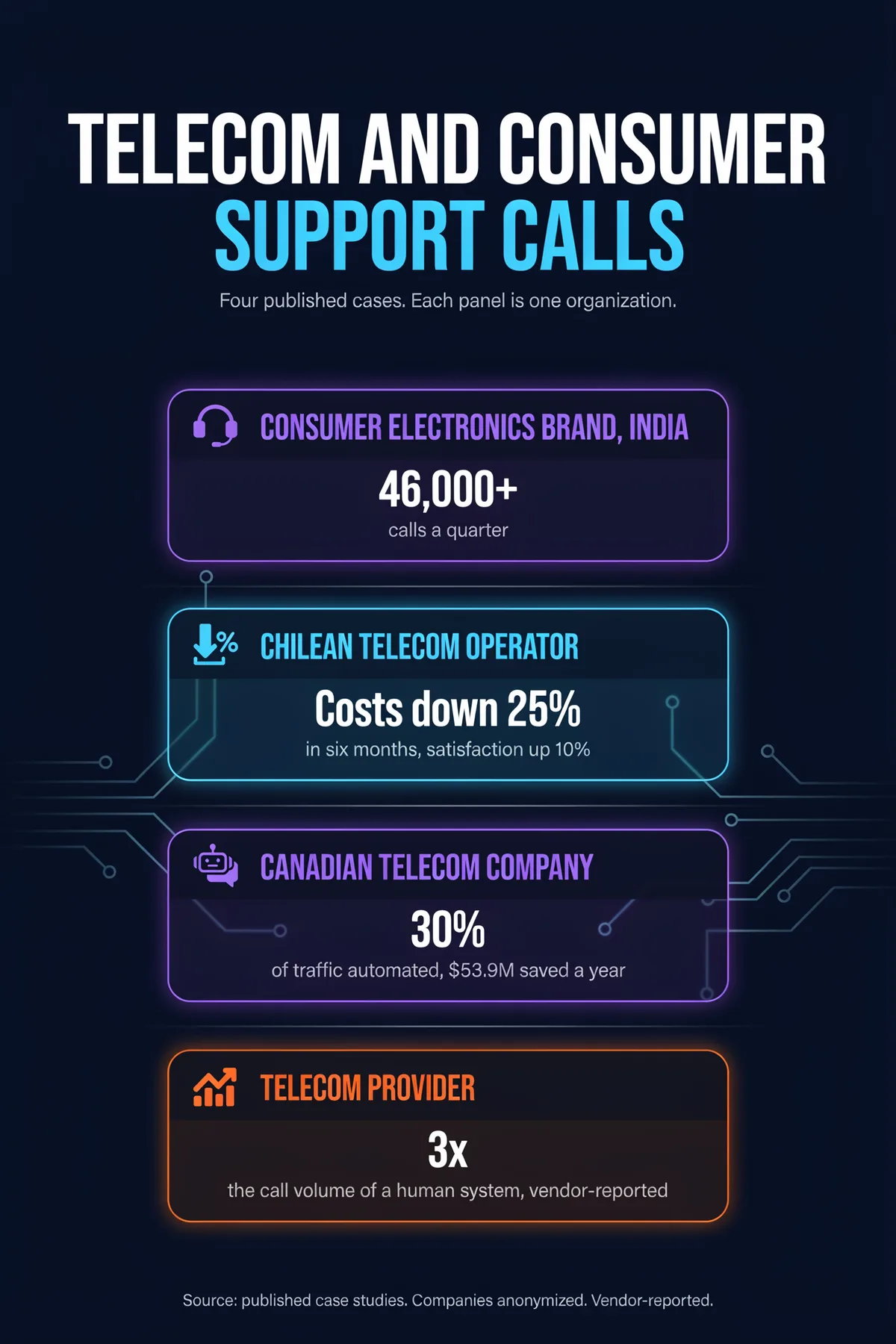
A Canadian telecom reports $53.9M saved a year. A Chilean operator reports costs down 25% in six months. Four published cases on telecom and consumer support.
John Park, Founder, Nebula AI14 min read
- How does call center automation work in telecom and consumer support?
- What a 24/7 voice agent did for a consumer electronics brand's India helpline
- How a Chilean telecom operator replaced its IVR with voicebots
- How a Canadian telecom company took 30% of its traffic with AI agents
- What a voice bot did for a telecom provider's call volume
- What the four cases prove about automating the routine call
- What to copy first
- If you want to build this
The short version: Call center automation in telecom pays when software takes the routine call and every call gets measured. A Canadian telecom company reports that 30% of its contact center traffic shifted to AI-powered automation and that it saves $53.9M a year, and an executive at a Chilean operator reports costs down 25% in six months.
Nobody calls their phone company, or the company that made their TV, to chat. They call because something is broken or a bill looks wrong, and the first thing they meet is a menu.
That menu is the real cost. The customer is already annoyed, the agent inherits the annoyance, and the company pays for every minute of both. These four published cases are about replacing the menu with something that listens.
They come from vendors' and companies' own case studies. The companies are anonymized and the sources stay named, so every number can be checked: a consumer electronics brand's India helpline, a Chilean telecom operator, a Canadian telecom company, and a telecom provider the source itself does not name. A wider set of results across industries sits in a roundup of real voice and answering outcomes.
How does call center automation work in telecom and consumer support?
Call center automation puts software on the routine call and a person on everything else. In these cases a voicebot replaced IVR menus, an AI agent took 30% of one telecom's contact center traffic, and a helpline stayed open around the clock. Calls the software cannot resolve go to a person.
That is narrower than "AI runs the call center," and it is the claim the cases support. Nobody here removed the people. They changed which calls reach them.
The cases also show that "AI" covers different jobs. One is a phone helpline. One replaced a menu system with voicebots. One is a set of AI agents across chat, voice, and video, with analytics on every call. One is a bot tuned for reply speed. Read each number against its own job.
What a 24/7 voice agent did for a consumer electronics brand's India helpline
Situation
The India operation of a consumer electronics brand, with a fast-growing customer base and a large network of dealers. A flood of queries met limited agent availability, and requests that arrived after working hours piled up and delayed resolution. The company wanted a dedicated 24/7 helpline for sales and service support, one that had to connect to its customer records system.
What changed
The brand deployed a voice agent that runs a 24/7 helpline for consumers and dealers in English, Hindi, and Bengali. Callers can register a device, troubleshoot, ask about products, request an installation, find a store, or transfer to a live agent for complex questions. The agent is integrated with the brand's customer records system, and it identifies the caller's state, city, and area from a spoken postal code to offer location-based help.
This is an AI voice agent on a phone helpline, with human transfer built in.
Results
The voice agent handles 46,000+ calls a quarter, and 13,000+ monthly service requests go through it. The company's national head of customer service reported over 21,000 calls handled within two months of going live.
| What the published account reports | Detail |
|---|---|
| Calls handled | 46,000+ a quarter |
| Monthly service requests | 13,000+ |
| Calls in the first two months | 21,000+ |
| Languages | English, Hindi, Bengali |
| Hours | 24/7, for consumers and dealers |
| Handoff | Live agent transfer on request |
"Handled" is not "resolved." The source says the monthly requests lead to customer fulfillment, but it does not say how many calls ended without a person. The case is also from 2023, so the numbers are a few years old. What it does show is volume: a helpline that never closes, in three languages, for two different kinds of caller.
How a Chilean telecom operator replaced its IVR with voicebots
Situation
A Chilean telecom operator that sells TV, internet, telephony, and mobile service, with 1,200 agents across three contact centers handling calls, chat, and WhatsApp. Customers calling in met complex IVR menus. The company set itself targets of raising customer satisfaction by 20% and cutting costs by 30% in the first year and another 15% after that.
What changed
The operator became, by its own account, one of the first companies worldwide to largely replace IVR with voicebots. It did not switch everything at once. It piloted voicebots on prepaid and roaming mobile services, which make up about one-third of all inquiries, and then rolled them out to contract customers and its most valuable accounts. When the bot cannot resolve a call, it routes the call to a specialist with the right skills. The company also put a bot link on its website and mobile app, where the bot can make an offer when a customer shows interest in buying. Job roles changed too: fewer people handle calls, and new teams teach the bots and tune the self-service journeys.
This is an AI voicebot replacing an IVR, with a web and app bot alongside it.
Results
The customer experience divisional manager reports a 5% uplift in revenue, a 10% rise in customer satisfaction, and costs down 25% within the first six months. The page also reports a significant reduction in abandonment rates, call transfers, and callbacks, with no figures attached.
| What the published account reports | Detail |
|---|---|
| Cost | Down 25% within six months |
| Customer satisfaction | Up 10% |
| Revenue | Up 5% |
| Abandonment, transfers, callbacks | Significant reduction, no figure given |
| Source of the three figures | One executive's quote |
| Agents | 1,200 across three contact centers |
The page's headline figures repeat one executive's statement, and it gives no baseline for the revenue or satisfaction numbers. The company's targets were 20% more satisfaction and 30% lower costs over the first year, and the page's own heading says those were "firmly within reach" after six months. Treat the figures as the company's claim, not a measurement you can reproduce. The sequence is the useful part: start with a third of the calls, prove it, then expand.
How a Canadian telecom company took 30% of its traffic with AI agents
Situation
A Canadian telecom company, with wireless, internet, and TV plus health and agriculture businesses, whose digital services arm fields more than 22 million customer calls a year. Its legacy systems relied on strict scripts and rigid rules. Data sat in silos, so every channel remembered only its own conversations, and a customer who moved from chat to voice to video had to explain the problem from the beginning. The company could analyze only about 1% of its calls.
What changed
The company unified its data on one platform. AI agents now handle chat, voice, and video support, understand natural language, and carry the customer's context from one channel to the next, so a customer who moves from chat to a video session does not start over. A quality analysis tool listens for long silences and tone of voice and triggers real-time coaching for human agents on difficult calls. AI also feeds frontline staff recommendations during live calls. Every one of the 22 million annual calls is now analyzed, and engineers use the conversation logs to build specialized agents in days instead of months.
This is a set of AI agents across chat, voice, and video, plus analytics on every call. It is not a voice-only bot.
Results
The company reports that 30% of its contact center traffic shifted to AI-powered automation, $53.9M in annual operational cost savings, and the average time to resolve issues down 87%. Calls analyzed went from about 1% (200,000) to all 22M+ a year.
| What the published account reports | Detail |
|---|---|
| Contact center traffic shifted to AI automation | 30% |
| Annual operational cost savings | $53.9M |
| Average time to resolve issues | Down 87% |
| Calls analyzed per year | From about 200,000 to 22M+ |
| Channels | Chat, voice, video |
| Source | Company case study published by its cloud vendor |
The savings are credited to "increased use of conversational agents and better customer insights," and the page does not split the $53.9M between the two. The 87% has no stated baseline either. So the headline number is not the dollar value of automating phone calls. It is the value of automating a share of traffic and understanding every call, and the second part is the one that is easy to copy.
What a voice bot did for a telecom provider's call volume
Situation
A telecom provider whose customer care calls ran into long hold times and high abandonment, with routine inquiries overloading human agents. The source does not name the company, and it describes only "a client in the Telecom domain." Voice added its own problems: reply latency, interruptions, and background noise, all inside a few seconds of conversation.
What changed
The vendor built an automated calling system on a large language model stack, with speech-to-text and text-to-speech, plugged into the telecom's existing Asterisk dialer. It handles repetitive queries, payment reminders, and frequent updates, and it can pull answers from the client's knowledge base. The team tuned for latency by using streaming responses, handled interruptions in custom code, and added noise reduction. It currently supports US English.
This is an AI voice bot on calls, and the source does not separate inbound from outbound use.
Results
The vendor says the system handles 3x the call volume of a human system, delivers 42% faster responses, and keeps hold times under one minute.
| What the vendor reports | Detail |
|---|---|
| Call volume | 3x, "triple the inquiries of a human system" |
| Responses | 42% faster, after reducing latency |
| Hold time | Under 1 minute |
| Language | US English |
| Client | Not named in the source |
Two limits apply. The 42% describes how fast the bot replies after the team cut latency, not how fast a caller's problem gets solved. And with no named client, no timeframe, and no baseline, this is the least checkable result in the post. It stays in because it shows the engineering problem under every voice bot: a long pause feels like a broken line.
What the four cases prove about automating the routine call
Four different jobs sit under the word automation. A helpline in three languages never closes. An operator starts with a third of its inquiries and expands once it works. A telecom giant stops sampling 1% of its calls and listens to all of them. A bot gets faster until it stops sounding broken. None of them removed the people. They changed which calls reach them.
Read each number against the job it came from. The Chilean operator's 25%, 10%, and 5% are one executive's words, not a measurement. The Canadian company's 30% and $53.9M cover agents across chat, voice, and video plus analytics, so they are not the price of a phone bot. The telecom provider's 42% is how fast its bot replies, not how fast a problem closes. The India helpline's 46,000 is calls handled, not calls resolved. Before you copy any of them, find out which case it came from.
A savings number with no baseline is a story, not a measurement.

Photo by Vitaly Gariev on Unsplash.
What to copy first
You probably do not field 22 million calls a year. If you run a $2M to $100M business, you have a smaller version of the same problem, and the first steps cost almost nothing.
Copy in this order:
- Start with the simple, high-volume question. The Chilean operator began with prepaid and roaming service, about a third of its inquiries, before extending to contract customers and top accounts.
- Route what the bot cannot resolve to the right person. The Chilean operator sends unresolved calls to a specialist with the right skills, and the India helpline offers a live agent on request.
- Measure every call, not a sample. The Canadian company analyzed about 1% of its calls before and all 22 million after, and says it now identifies root causes with certainty.
- Keep the customer's context across channels. The same company's customers used to restart when they moved from chat to voice to video. Nobody should have to explain the problem twice.
- Treat latency as a feature. The telecom provider's team worked on streaming responses, interruptions, and background noise, because a slow bot sounds broken.
- Write down your baseline and your target first. The Chilean operator set first-year targets of 20% and 30% and reported 10% and 25% after six months. The telecom provider published no baseline, which makes its numbers hard to trust.
The shape of the fix does not change with size: answer the routine call, send the rest to a person with the right skills, and measure all of it.
If you want to build this
Do the boring version first. Open your call log, write down the ten questions that fill it, answer each in two lines, and make one person own those answers. Measure your current wait and abandon rates the same week, so you have a before.
The wiring layer is Make.com. It passes the call's details to whatever your agent already has on screen, and the caller stops repeating themselves.
For the voice layer, most teams start with Retell AI or Vapi. Voice is the first thing a caller judges: a November 2025 Twilio blind test found 90% of consumers could not pick an AI voice from a human one even though 72% expected to, and the natural voices from ElevenLabs are a large part of why.
Telecom adds one habit worth copying from the largest case here. The Canadian company went from analyzing about 1% of its calls to all of them. Automating the phone without listening to the calls afterward trades one blind spot for another.
An AI receptionist is one of the digital employees we build, and how it compares to an answering service is the same problem at small-business scale.
If you want your own baseline and target written down before you buy anything, book a free discovery call and we will set them together.
The numbers in this article come from each provider's or company's published case study: Yellow.ai's case study for the consumer electronics brand's India helpline, Genesys's case study for the Chilean telecom operator, Google Cloud's case study for the Canadian telecom company, and Pragmatyc's case study for the telecom provider. The telecom provider's figures are vendor-reported and its client is unnamed in the source. The Chilean operator's figures are an executive's quoted claim. These are real anonymized case studies that show what voice AI can do in practice. Some links in this post are affiliate links: if you sign up through them, we may earn a commission at no extra cost to you.
Frequently Asked Questions
What share of telecom calls can AI automate?
The published cases give different shapes of answer. A Canadian telecom company reports that 30% of its contact center traffic shifted to AI-powered automation. A Chilean operator says its voicebots now handle almost all the queries its old IVR menus used to automate. The consumer electronics helpline publishes a call count, not a share. None of the figures is independently audited.
How is a voicebot different from an IVR menu?
An IVR makes the caller navigate menus and press keys. A voicebot lets the caller say what they need and works out the intent. The Chilean operator's executive says callers no longer navigate complex IVR menus, and the Canadian company describes legacy systems built on strict scripts and rigid rules. If the bot cannot resolve the call, it routes it to a person.
Do savings like $53.9M apply to a smaller company?
Not as a number. That figure belongs to a company that fields more than 22 million customer calls a year, and it combines conversational agents with better customer insights. The pattern scales down: start with the routine call, route the rest to people, and measure everything. Price any tool against your own call volume, because none of these cases publish unit costs.
Is every number here a voice AI result?
No, and the labels matter. The Canadian company's results come from AI agents across chat, voice, and video plus call analytics, not a voice bot alone. The Chilean operator's three figures are one executive's quoted claim. The telecom provider's 42% describes how fast the bot replies. The helpline's call counts measure calls handled, not calls resolved.
Where do these numbers come from?
Every figure comes from a vendor's or company's published case study, not from a Nebula AI measurement. Yellow.ai published the consumer electronics helpline, Genesys the Chilean operator, Google Cloud the Canadian company, and Pragmatyc the telecom provider. These are real anonymized case studies that show what voice AI can do in practice. All results are vendor-reported or company-reported, not independent audits.
Founder of Nebula AI. Builds AIOS for established businesses.
Get one practical AI idea for your business, once a month.
Put this to work in your business
Not sure where your phone calls are leaking?
Book a free discovery call and we will map the calls you are missing to the jobs they should have been. Half an hour, no pitch deck.
 Case Study15 min read
Voice AI for Banking: 4 Published Results on Calls
A Swiss bank cut call processing time about 20%. A US credit union reports 66% of calls automated. Four published banking cases on routine calls and waits.
 Case Study13 min read
AI Calls for Admissions and Agencies: 4 Real Results
An online school saved advisors 100,000+ minutes a month. A studio lifted leads 50% by answering every call. Four published cases on admissions and agencies.