

Can Voice AI Handle Patient Calls? 5 Healthcare Cases
A diagnostics firm contained 45% of calls with a virtual agent. A hospital network answers most of 1,200 daily calls. Five published healthcare cases.
John Park, Founder, Nebula AI13 min read
- What can voice AI actually handle in healthcare?
- What a medical answering service did for a molecular diagnostics company
- A vision insurer that took its virtual agent in house
- A medical equipment provider that cut inbound calls 15%
- A health insurer and a million provider calls a month
- A hospital network in Telangana with 1,200 calls a day
- What to copy first
- If you want to build this
The short version: In healthcare, the phone is still the front door, and routine calls are what bury the desk: scheduling, status, benefits, routing. Software can take that layer, and the numbers below show the stake. A diagnostics company contained 45% of its calls with a virtual agent, and a hospital network now answers the majority of 1,200 a day.
Portals were supposed to absorb this traffic, and they didn't. Patients still call to book, providers still call to check benefits, and families still call about a lab result.
The desk does not lose most of these calls because the staff is slow. It loses them because routine volume is relentless, the lines are busiest exactly when the waiting room is full, and the phone menu was never built to answer anything.
Five published examples follow, none of them clients of this site. A global diagnostics company, a national vision benefits insurer, a home medical equipment provider, a major health insurer, and a four-facility hospital network in Telangana, India, each labeled for what it actually ran. A wider set sits in a roundup of real voice and answering results.
What can voice AI actually handle in healthcare?
It absorbs the routine calls: appointment booking, doctor availability, lab report status, benefits and eligibility questions. Those are the calls that fill a front desk and push hold times past ten minutes. The five published cases below range from a diagnostics firm containing 45% of its calls to a hospital network answering most of 1,200 a day.
Emergencies are rare on these lines. What floods a healthcare desk is the repeatable: appointment booking, rescheduling, a status check, a benefits question, a routing decision. All five examples attack that layer, in three ways, which are worth separating before you shop.
Containment means the software resolves the call completely and no human touches it. Self-service means the caller gets an answer without waiting for an agent. Routing means the calls that do need a person reach the right person. Each example below is one of those three, or a mix.
The labels matter because the products differ. A live answering desk, a virtual agent, and a contact-center migration get sold in the same breath, and they are not the same purchase. The numbers only transfer if you copy the layer that produced them.
What a medical answering service did for a molecular diagnostics company
Situation
A global molecular diagnostics company in cancer detection, operating across multiple sites. The published situation: an inflexible IVR, no ability to scale, and overwhelming call volumes landing on an on-premises contact center.
An inflexible IVR fails in a specific way. It promises an answer, delivers a menu, and the caller presses zero anyway. A person checking a test status then waits in the same queue as everyone else.
What changed
The company moved to a cloud contact center and put an intelligent virtual agent in front of routine calls. This was a genuine AI virtual agent deployment, so software held the conversation rather than a live desk taking messages or a menu with new prompts.
The numbers below describe self-service absorbing routine volume, and that is all they are evidence of.
Results
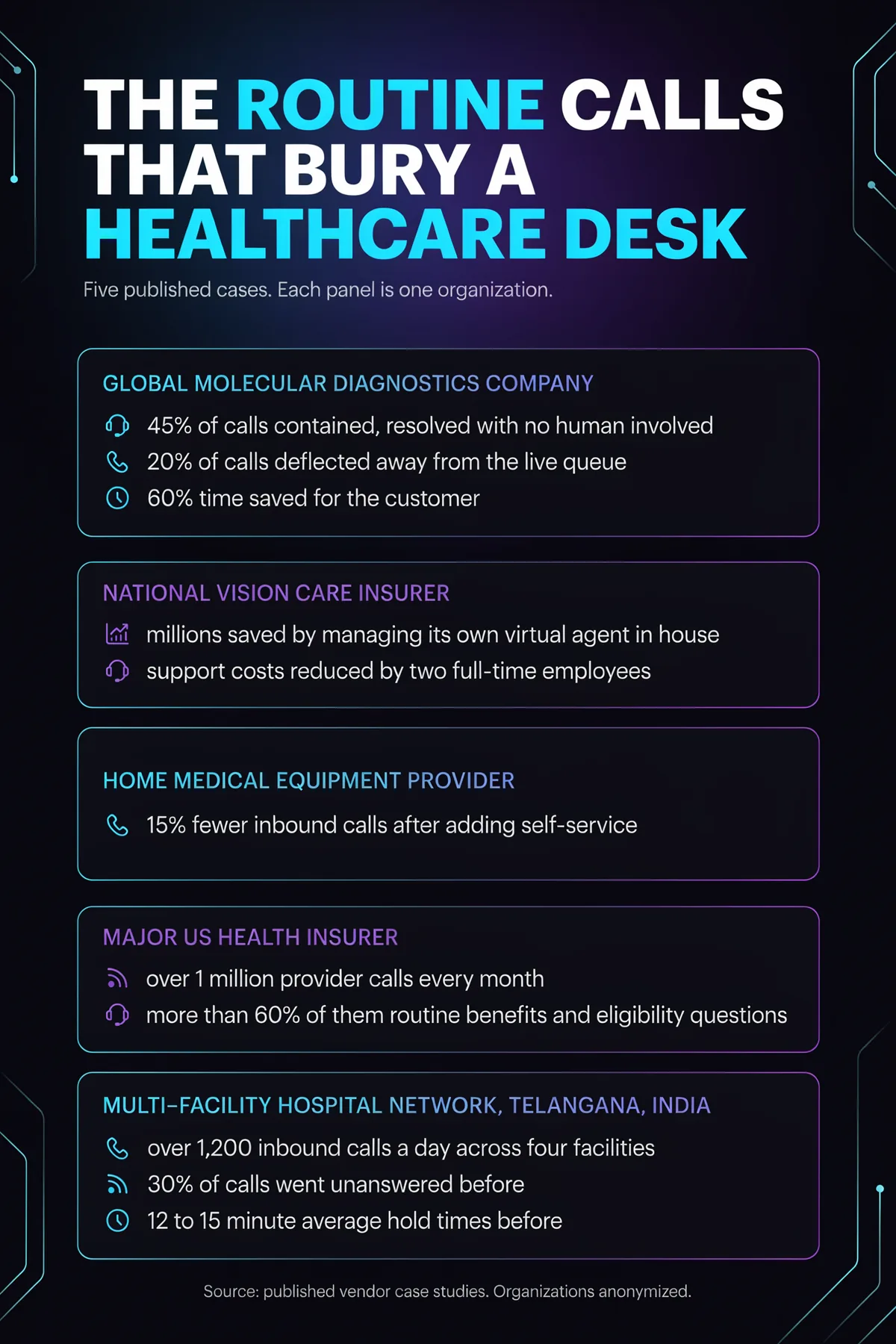
A 45% call containment rate. 20% call deflection overall. 60% time savings for customers.
| What the published account reports | Detail |
|---|---|
| Call containment rate | 45% |
| Call deflection overall | 20% |
| Time savings for customers | 60% |
| What ran | Intelligent virtual agent on a cloud contact center |
| Footprint | Global, multi-site, cancer detection |
Healthcare call containment means the share of calls the software resolves with no human involved. The call deflection rate, 20% here, counts the calls steered away from the live queue altogether. The 60% is time saved for the customer, not for the contact center, and the containment figure credits routine calls rather than complex ones, per Five9's published case study.
A vision insurer that took its virtual agent in house
Situation
A national vision care insurer in the United States, a vision benefits specialist, with self-service reaching 12 million members. The published situation: an on-premises contact center that could not scale, could not keep the cost of managing its intelligent virtual agent down, and could not support a remote workforce.
What changed
The insurer moved to a cloud contact center and took ownership of managing its own virtual agent. That is a different story from the others here: rather than deploying a new agent, the insurer brought the management in house instead of paying a vendor to run it.
Results
| What the published account reports | Detail |
|---|---|
| Savings from owning IVA management | Millions of dollars |
| Support costs | Reduced by two full-time employees |
| Workforce | 100% remote, enabled by the move |
| Self-service reach | 12 million members |
| Footprint | National, US-wide |
The published source gives neither a routing percentage for the virtual agent nor a specific dollar total, so there is nothing more precise to quote here than the millions saved. The fully remote workforce is a result in its own right, and the platform is what made it possible.
A medical equipment provider that cut inbound calls 15%
Situation
A home medical equipment provider in the US. The published situation is short: high inbound call volume, and much of it routine questions. Every one of those calls holds a person who could be working an order that actually needs one.
What changed
The provider added a virtual agent so patients could self-serve, plus generative AI call summaries for the calls that still reached staff. The two tools do different jobs, in that one removes the call and the other shortens the call that remains. This is a modest self-service result.
Results
| What the published account reports | Detail |
|---|---|
| Inbound call volume | down 15% |
| Average handle time | Trimmed, no figure published |
| What ran | Virtual agent plus generative AI call summaries |
| Footprint | US, home medical equipment |
Fifteen percent is not a headline, and that is why it is credible. Volume that used to reach a person now answers itself. On its own that will not transform a desk, but it is a real reduction in the calls your staff have to take.
A health insurer and a million provider calls a month
Situation
A major US health insurer covering Medicare, dental, vision, and pharmacy, with more than 13 million customers. Its legacy IVR transferred far too many calls to human agents, and those transfers were expensive. The provider line alone received over one million calls every month, and more than 60% were routine pre-service questions about benefits and eligibility, with well-defined answers.
That last number is the whole story before any AI exists. When most of a million monthly calls have a fixed answer, the cost is not in the questions but in routing them to a person anyway.
What changed
The insurer deployed conversational AI to handle the routine pre-service provider calls and reduce the costly transfers, so providers with a benefits question got an answer from software and the calls that genuinely needed a person stopped competing with them.
Results
| What the published account reports | Detail |
|---|---|
| Provider calls per month | Over 1 million |
| Routine pre-service share | More than 60% |
| Costly pre-service calls reaching agents | Reduced |
| Provider experience | Improved |
| What ran | Conversational AI |
| Footprint | US, more than 13 million customers |
IBM's published case study does not state a percentage improvement, so there is none to quote. What it does publish is fewer costly pre-service calls reaching agents and an improved provider experience. The callers here were providers rather than patients, though the routine-volume logic works the same for both.
A hospital network in Telangana with 1,200 calls a day
Situation
A multi-facility hospital network in Telangana, India, four facilities. Over 1,200 inbound calls a day across the locations. More than 30% of calls went unanswered, and average hold times ran 12 to 15 minutes. The front desk was juggling walk-in patients, physician coordination, insurance, and the phones at the same time.
Thirty percent unanswered is the number to sit with. At that volume it is more than 360 calls a day hearing silence and hanging up, and some of those callers were new patients with a choice of hospitals.
What changed
The network deployed a healthcare-specific AI voice agent integrated with the hospital management system. The agent handles appointment booking and rescheduling against real-time doctor availability, lab report status, and pharmacy queries. Patient scheduling is the core of it, because the booking lands in the hospital's own system rather than in a note for the morning shift.
Results
| What the published account reports | Detail |
|---|---|
| Inbound calls per day | Over 1,200 across four facilities |
| Unanswered calls before | More than 30% |
| Hold times before | 12 to 15 minutes on average |
| Calls handled autonomously | The majority |
| Hold times after | Cut |
| Clinical staff | Freed for higher-value work |
| New-patient registrations | Fewer lost to faster-answering competitors |
ElidePro's account says the agent handled the majority of calls autonomously and cut hold times, and that clinical staff were freed for higher-value work. The competitive detail is worth underlining: new-patient registrations were being lost to hospitals that answered faster, so a ringing line at a hospital is not an inconvenience but a patient choosing the next door.

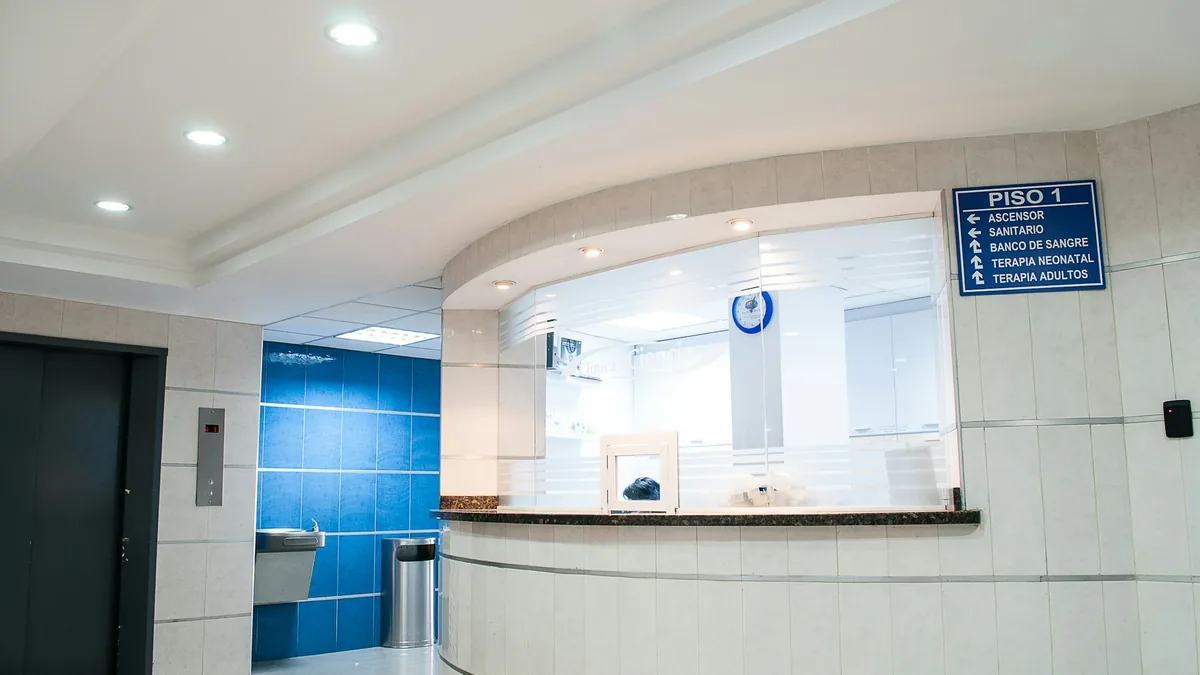
Photo by Luis Melendez on Unsplash.
What to copy first
The leak in all five examples is the same layer: routine volume. The scale differs, from a global diagnostics company to a four-facility network, but the shape holds. Software answers the routine share, integration puts the result in the system of record, and people keep the judgment calls.
It is worth keeping the layers straight even if you only care which one to buy. A genuine AI virtual agent produced the 45% containment. The vision insurer's millions came from owning its virtual agent management rather than from a new agent. The equipment provider's 15% is pure self-service. The insurer's provider story is conversational AI. The hospital ran an AI voice agent into its hospital management system. If a pitch uses one of these numbers to sell you a different product, it is worth walking away.
Copy in this order:
- Count first. The Telangana network knew the leak because it was measured: 1,200 calls a day, more than 30% unanswered, 12 to 15 minute holds. Your version of that count is two weeks of call logs.
- Write down the routine questions with well-defined answers: benefits, eligibility, appointment changes, report status, pharmacy questions. At the health insurer, more than 60% of a million monthly provider calls were exactly that. Most desks carry a similar share.
- Put software in front of the routine share, and wire it into the system of record. The hospital agent books into the HMS. A booking that lands anywhere else is a conversation someone retypes.
- Keep a clean handoff rule. Containment only counts when the complex calls still reach a person, with context. The diagnostics company contained 45%, and the other calls had somewhere to go.
- Measure containment and the call deflection rate before and after. Forty-five and twenty are one company's published scoreboard. Yours will differ, so you will want the before number.
Nights are part of the same leak. An after hours answering service covers them with people, and a voice agent covers them with software that keeps booking while the office is dark. Decide which layer you are buying, because a live desk, an agent, and a platform migration are three different purchases.
The shape of the fix is always-on intake for dental and healthcare practices: answer the call, contain the routine volume, and route the rest cleanly to a person.
If you want to build this
The first version is a call log and a person who answers the phone. Do that before you buy anything. When the routine list gets long enough to automate, you have two paths, and they are not the same product.
A live medical practice answering service keeps a human on the line and hands off notes. It is the right choice when the desk needs judgment in the loop and the callers need a person. It is also a recurring bill.
Or have software answer the routine share itself. Voice-agent platforms like Retell AI and Vapi are where most teams start: the agent books, reschedules, answers status questions, and escalates what it cannot handle. Make.com is the wiring layer that pushes a booking or a missed call into the practice management system your schedule already lives in.
Healthcare adds a layer other industries do not carry: patient data. Before one call is recorded or stored, ask for HIPAA-eligible infrastructure and a signed business associate agreement. There is no HIPAA certification. Compliance is configuration, and it is decided before the first call, not after.
If you go the agent route, the voice decides whether the caller stays on the line. A November 2025 Twilio blind test found 90% of consumers could not correctly identify an AI voice from a human one, though 72% believed they could. Neural voices from ElevenLabs are a large part of why that gap exists. You still need the script, the integration, and a rule for when a person takes over.
The single-practice version of this front desk is written up in how an AI receptionist works for medical and dental practices. Same leak. Different scale. Label it before you buy it.
Not sure which layer your phones need? Book a free discovery call and we will map the routine calls burying the desk to the ones that genuinely need a person, without pretending a live desk and a voice agent are the same thing.
The numbers in this article come from each provider's published case study: Five9 for the molecular diagnostics company, the national vision care insurer and the home medical equipment provider, IBM for the health insurer, and ElidePro for the hospital network in Telangana. These are real anonymized case studies that show what voice AI can do in practice. Some links in this post are affiliate links: if you sign up through them, we may earn a commission at no extra cost to you.
Frequently Asked Questions
What is call containment?
The share of inbound calls the software resolves completely, with no human agent involved. A patient who books a reschedule with the virtual agent and never reaches the desk was a contained call. The diagnostics example published a 45% containment rate, alongside a 20% deflection rate, which counts the calls steered away from the live queue altogether.
Is this AI or people answering the phones?
AI, according to the published sources. The diagnostics company, the medical equipment provider, and the hospital network ran virtual agents or a healthcare voice agent. The health insurer deployed conversational AI on provider calls. The vision care insurer is the partial exception: its published result came from taking management of its intelligent virtual agent in house, so the story is ownership rather than a new agent.
Does this work for a small practice?
These five published examples are large organizations, so they are not proof about a two-chair practice. The pattern transfers anyway. Most practices carry a similar routine share, such as scheduling, status, and benefits questions, and software can take those first. Start with one call type, measure it for a month, then widen the scope.
What should a practice fix first?
Log what the phones actually carry for two weeks before buying anything. Then fix the routine calls with well-defined answers first, the way the health insurer did with benefits and eligibility. Make sure a booking lands in the scheduling system you already use, and measure the share of calls handled without a person before and after.
Where do these numbers come from?
Each figure comes from a provider's published case study, not from a Nebula AI measurement. Five9 published the molecular diagnostics company, the vision care insurer, and the home medical equipment provider. IBM published the health insurer. ElidePro published the hospital network in Telangana. These are real anonymized case studies that show what voice AI can do in practice. All numbers are vendor reported.
Founder of Nebula AI. Builds AIOS for established businesses.
Get one practical AI idea for your business, once a month.
Put this to work in your business
Not sure where your phone calls are leaking?
Book a free discovery call and we will map the calls you are missing to the jobs they should have been. Half an hour, no pitch deck.
 Case Study15 min read
Voice AI for Banking: 4 Published Results on Calls
A Swiss bank cut call processing time about 20%. A US credit union reports 66% of calls automated. Four published banking cases on routine calls and waits.
 Case Study13 min read
AI Calls for Admissions and Agencies: 4 Real Results
An online school saved advisors 100,000+ minutes a month. A studio lifted leads 50% by answering every call. Four published cases on admissions and agencies.