

AI Receptionist for Law Firms: How It Works and Costs
Most law firms answer only 40% of calls live, and clients don't wait. Here's how an AI receptionist works, what it costs, and the revenue it wins back.
John Park, Founder, Nebula AI8 min read
- What is an AI receptionist for a law firm?
- How does an AI receptionist actually work?
- Why do law firms lose clients before the phone stops ringing?
- What results do law firms see when every call gets answered?
- Is this replacing my staff or helping them?
- What does it cost and how fast can it go live?
- Is my client data safe?
- Is an AI receptionist right for your firm?
The short version: Most law firms answer only 40% of their calls live, and the caller who doesn't reach you rarely waits. An AI receptionist answers every call day and night, works out what the caller needs, books the good ones into your calendar, and passes the rest to your team. Below: how it works in plain English, what firms are seeing, what it costs, and whether the data is safe.
Your phone is ringing right now, and there's a decent chance nobody is picking it up.
Clio's 2024 Legal Trends Report sent secret shoppers to 500 U.S. law firms. Only 40% answered the phone live. Nearly half, 48%, were effectively unreachable: no answer, no callback. And when a firm did miss a call, only 20% ever called back.
That caller is not sitting by the phone hoping you ring back. They are dialing the next firm on Google.
This is the gap an AI receptionist closes. Not a robot reading a script. A system that answers, understands, and books, every hour of every day. Here is how it actually works, what it costs, and what it does to a firm's numbers.
What is an AI receptionist for a law firm?
An AI receptionist is software that answers your phone in a natural voice, has a real conversation with the caller, captures their details, screens the matter, and books qualified prospects straight into your calendar. It works nights, weekends, and holidays, and it never puts anyone on hold. Think of it as a front-desk hire that clocks in 24/7 and never misses a call.
It is not an answering machine. It is not a phone tree with "press 1 for billing." It talks, it listens, and it acts.
How does an AI receptionist actually work?
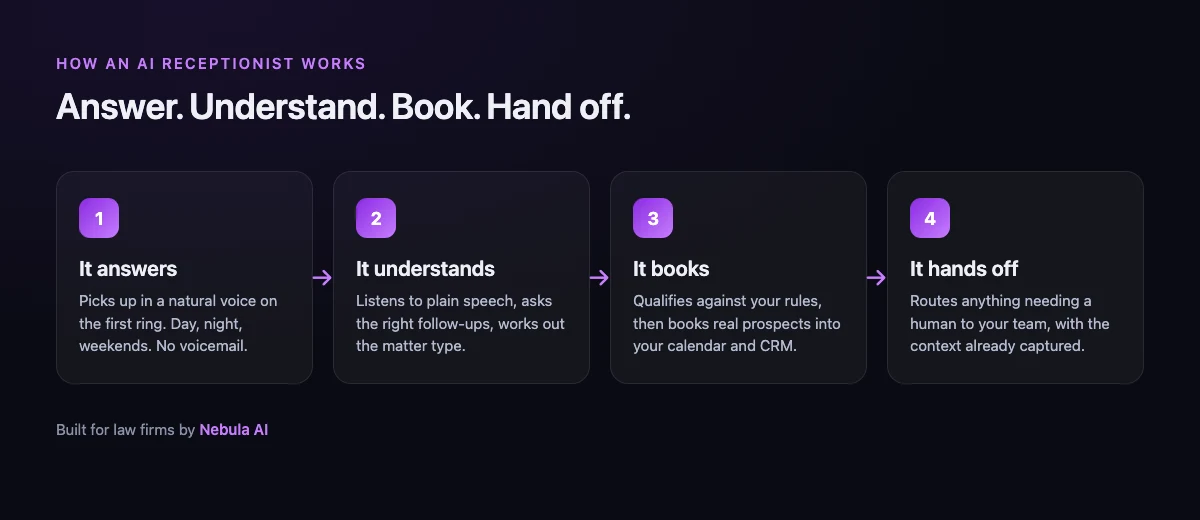
You do not need to understand the engineering to run one. Here is the whole thing in four steps.
1. It answers. The moment a call comes in, the AI picks up in a natural human voice. No ringing out, no voicemail, no "our office is currently closed."
2. It understands. The caller talks the way they would to a person. "I was in a car accident last week and I think I need a lawyer." The AI understands plain speech, asks the right follow-up questions, and works out what kind of matter this is.
3. It qualifies and books. Based on your rules, it decides whether this is a real opportunity or a timewaster. Real ones get booked into your calendar and logged in your CRM on the spot. No sticky notes, no lost callback slips.
4. It hands off. Anything that needs a human, an existing client, an urgent matter, a complex question, gets routed to the right person with the context already captured. Your team only touches the calls that need them.
That is it. Answer, understand, book, hand off. The caller gets a fast, helpful response. You get a qualified consultation on the calendar instead of a missed call.
But won't callers know it's a robot?
A few years ago, yes. Today, no.
Modern voice AI does not sound like the flat, robotic systems you remember. Neural voice tools like ElevenLabs generate speech with natural rhythm, pauses, and warmth. In a November 2025 blind test by Twilio, 90% of consumers could not correctly tell an AI voice from a human one. The catch: 72% of them believed they could.
Callers are not phoning to admire your phone system. They want their question answered fast. And they get it.
Why do law firms lose clients before the phone stops ringing?
A missed call at a law firm is not a small annoyance. It is a client walking out the door before they ever sat down.
The reason is speed, and the data on speed is brutal.
Harvard Business Review's study The Short Life of Online Sales Leads found that firms which respond to a new lead within an hour are about seven times more likely to qualify that lead than those who wait even one hour longer. In the same audit, 23% of companies never responded at all.
It gets sharper. A widely cited lead-response study from MIT and InsideSales found that contacting a lead within five minutes instead of thirty makes you 21 times more likely to qualify them.
And legal clients shop around. Martindale-Avvo's 2023 consumer research found that 78.9% of people hiring a lawyer contact more than one firm, and 80% will move on to another attorney if they do not hear back within 48 hours.
Put it together. Your prospects are calling several firms. The first one to give them a real answer usually wins. And most firms are answering 40% of the time.
You do not have a marketing problem. You have a response problem. You are paying to make the phone ring, then letting the call go to voicemail.
What results do law firms see when every call gets answered?
The theory is fine. Here are documented results from firms that closed the response gap, so new callers and web leads got a fast answer instead of a voicemail. These are their published numbers, not ours. They show what happens when the first response stops falling through the cracks, whoever or whatever handles it.
| Firm | What they fixed | Result |
|---|---|---|
| Ziegler Diamond Law Firm | Slow follow-up on web leads | 324 leads worked per month, 52% booked into consultations, 42 new clients a month |
| Ticket Crushers | Missed calls going to competitors | 80% of qualified leads converted, 40% increase in annual revenue |
| Right Law Group | Website visitors falling through the cracks | 95% of leads captured and processed automatically |
Different firms, different practice areas, same fix. None of them hired more attorneys to get these numbers. They stopped losing the leads they already had.
The pattern underneath all three:
✓ Every call and web lead answered, day or night
✓ Qualification handled before a human gets involved
✓ Everything synced to the calendar and CRM automatically
The lead used to sit and go cold. Now it gets worked in minutes.
Is this replacing my staff or helping them?
Helping them. This is the part firms get wrong when they picture AI on the phones.
The AI takes the repetitive first response: the after-hours call, the "do you handle this kind of case" question, the intake form. Your paralegals and intake staff stop playing phone tag and spend their hours on casework and the conversations that actually need a person.
Gartner predicts that AI will autonomously resolve 80% of common service interactions by 2029. It also predicts that half of organizations will abandon plans to cut service headcount because of AI. The winning setup is not AI instead of people. It is AI on the repetitive front line, people on the work that needs judgment.
Adoption is already here. The American Bar Association's 2024 AI TechReport found 30% of lawyers now use AI tools, up from 11% a year earlier, and 46% at firms with 100 or more attorneys. The bigger firms are moving first. The question is not whether this becomes standard. It is whether you are early or late.
What does it cost and how fast can it go live?
Straight numbers.
A single AI employee, like a receptionist, typically starts around $3,000 to build plus about $1,500 a month to run. The exact figure depends on your call volume and how many systems it needs to connect to. A single role usually goes live in 1 to 2 weeks. A full intake department, several roles working together, runs 4 to 6 weeks.
Weigh that against one signed case. For most firms, a single matter the AI saves from going to voicemail pays for months of the system.
Is my client data safe?
Yes, when it is built correctly.
Client data should be encrypted in transit and at rest, sit behind role-based access, and be configured to match your firm's compliance obligations before the system ever answers a call. Confidentiality is not an add-on here. It is the starting requirement, and any serious build treats it that way.
Is an AI receptionist right for your firm?
If you are losing calls, drowning in after-hours leads, or watching good prospects go cold before someone follows up, this is the gap to close first.
Nebula AI builds this exact system for law firms: an AI receptionist that answers every call, qualifies the matter, books the consultation, and plugs into your calendar and CRM. Live 1 to 2 weeks after your AI Diagnostic.
Two ways to start:
- Book your AI Diagnostic call and we will map it to your actual call volume and intake process.
- Prefer to explore first? Run the free AI Blueprint and get a plan built around your firm.
Still deciding between AI and a traditional service? Read AI receptionist vs answering service next, or see how we approach AI for legal firms.
Statistics in this article were accessed in July 2026 and link to their original sources inline.
Frequently Asked Questions
Will an AI receptionist replace my legal intake staff?
No. It handles the repetitive first response, answering calls, capturing details, and booking consultations, so your staff spend their time on casework and the calls that actually need a person.
How much does an AI answering service cost for a law firm?
A single AI employee, like a receptionist, typically starts around $3,000 to build plus $1,500 a month to run. The exact cost depends on call volume and how many systems it needs to connect to.
Is client intake data secure with an AI system?
Yes, when it is built correctly. Data should be encrypted in transit and at rest, with role-based access, and the system should be configured to match your firm's compliance requirements before it ever answers a call.
How many calls do law firms actually miss without one?
Per Clio's 2024 Legal Trends Report, only 40% of firms answer the phone live and 48% are effectively unreachable. When a firm does miss a call, only 20% of them ever call back. Most callers who do not reach a person simply call the next firm.
How fast can a law firm get an AI receptionist set up?
A single AI employee, like a receptionist, usually takes 1 to 2 weeks from kickoff to live. A full intake department takes 4 to 6 weeks.
Founder of Nebula AI. Builds AIOS for established businesses.
Get one practical AI idea for your business, once a month.
Put this to work in your business
Not sure where your phone calls are leaking?
Book a free discovery call and we will map the calls you are missing to the jobs they should have been. Half an hour, no pitch deck.
 Case Study15 min read
Voice AI for Banking: 4 Published Results on Calls
A Swiss bank cut call processing time about 20%. A US credit union reports 66% of calls automated. Four published banking cases on routine calls and waits.
 Case Study13 min read
AI Calls for Admissions and Agencies: 4 Real Results
An online school saved advisors 100,000+ minutes a month. A studio lifted leads 50% by answering every call. Four published cases on admissions and agencies.